
Total Medical Hair Care: Complete Medical and Surgical Hair Restoration Guide
Hair loss is more than a change in appearance. For many people, thinning hair can affect confidence, self-image, and the way they feel about getting older. That is why effective hair care should never focus only on the hair you can see.
At Dr Ruz Hair Transplant, Total Medical Hair Care takes a complete approach to hair loss. Instead of treating every patient with the same solution, the process begins by understanding why the hair is thinning, how quickly it is progressing, and what can realistically be achieved.
Most importantly, good hair restoration starts with an accurate diagnosis. Hair loss may develop because of genetics, hormones, medical conditions, nutritional problems, medications, or several factors working together. Therefore, identifying the cause is just as important as choosing the treatment.
Depending on your condition, treatment may include medical hair loss treatment, scalp care, medication, regenerative therapies, or a hair transplant. In some cases, a combination provides the best long-term strategy.
The goal is simple: protect the hair you still have, restore what can be restored, and create a natural-looking result that continues to look appropriate as you age.
What Is Total Medical Hair Care?
Total Medical Hair Care is a comprehensive approach to managing hair loss rather than relying on one treatment alone.
First, your hair and scalp need a proper medical assessment. Next, existing hair should be protected whenever possible. Finally, if sufficient hair has already been lost, hair restoration surgery may become part of the treatment plan.
This approach matters because a hair transplant does not stop future hair loss. Transplanted follicles can provide long-lasting growth, but the surrounding native hair may continue to thin.
For that reason, successful hair restoration usually combines three important areas:
Medical hair maintenance to protect existing follicles.
Surgical hair restoration when transplantation is appropriate.
Aesthetic planning to create natural density, direction, and facial framing.
As a result, the treatment plan becomes more than simply “putting hair back.” It becomes a long-term strategy for managing hair loss.
Why Does Hair Loss Happen?
Hair loss can have many causes. Genetic pattern baldness is one of the most common, but it is not the only explanation.
Genetics can make hair follicles increasingly sensitive to hormonal effects, particularly dihydrotestosterone (DHT). Over time, affected follicles become smaller and produce finer, shorter hairs. This process is known as follicular miniaturization.
However, other factors can also contribute to hair shedding or thinning. These include hormonal changes, systemic illnesses, nutritional deficiencies, certain medications, autoimmune conditions, and environmental or lifestyle stressors.
Sudden shedding also deserves attention. For example, a person who notices significant hair loss several months after a major physical or emotional stress may have a condition such as telogen effluvium.
Therefore, assuming that every case is ordinary male or female pattern hair loss can lead to the wrong treatment.
A proper consultation helps separate temporary shedding from progressive hair loss and distinguishes non-scarring conditions from diseases that can permanently destroy hair follicles.
Comprehensive Hair Loss Diagnosis
Before discussing a hair transplant in Malaysia or any other treatment, a detailed evaluation should come first.
During the consultation, the doctor may ask when the shedding started, whether it appeared suddenly or gradually, and which areas of the scalp are changing. Family history also matters, so both maternal and paternal patterns should be considered.
Your medication history, health background, scalp symptoms, hair-care practices, and previous treatments can provide additional clues.
Furthermore, emotional expectations are an important part of the consultation. Hair restoration is an elective procedure, so patients need realistic expectations about density, donor supply, healing, and the time required to see the final result.
Scalp and Hair Examination
A structured scalp examination can provide valuable information.
Pattern classification helps determine the distribution and severity of hair loss. Male pattern baldness can be assessed using the Norwood-Hamilton classification, while female pattern hair loss may be evaluated using systems such as Ludwig or Savin.
Scalp inspection looks for redness, scaling, inflammation, scarring, and the presence or absence of follicular openings. This distinction is important because scarring alopecia can permanently destroy follicles.
Hair pull testing can help identify active shedding. A gentle pull across different scalp areas may show whether an unusually high number of hairs are entering the shedding phase.
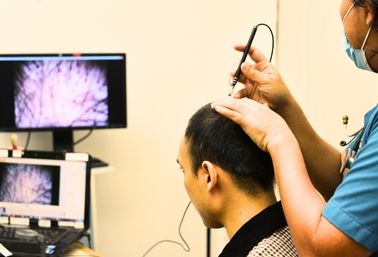
Trichoscopy, also called dermoscopy of the scalp, provides magnified visualization of the hair and scalp. It can reveal differences in hair diameter, miniaturization, empty follicular units, yellow dots, black dots, and other diagnostic signs.
In selected cases, a hair pluck test or microscopic hair examination may provide additional information.
When Are Blood Tests or a Scalp Biopsy Needed?
Hair loss sometimes reflects an underlying medical problem. Therefore, laboratory testing may be recommended when the clinical history suggests a reversible systemic factor.
Depending on the individual situation, investigations may include a complete blood count, ferritin, thyroid-stimulating hormone, vitamin D, and zinc. Additional autoimmune or infectious testing may be considered when clinically appropriate.
Women with signs of hormonal imbalance may require further endocrine assessment. Symptoms such as acne, increased facial hair, or irregular menstrual cycles can provide useful clues.
A scalp biopsy may also be necessary when the diagnosis remains uncertain. This is particularly important when scarring alopecia is suspected.
The key principle is straightforward: do not transplant into an undiagnosed or actively destructive scalp condition.
An accurate diagnosis protects both the patient and the potential hair transplant result.
Medical Hair Loss Treatment
Medical treatment is often the first step in comprehensive hair care.
The purpose is usually to slow hair loss, preserve existing follicles, and potentially improve the thickness of miniaturized hairs. However, most medical treatments do not permanently cure genetic pattern baldness.
Instead, they work while the treatment continues. Consequently, consistency matters.
Visible changes also take time. Many patients need several months before they notice meaningful improvement. In some cases, early shedding can occur before the hair enters a more active growth phase.
Minoxidil
Minoxidil is one of the most established medications used for pattern hair loss.
Topical formulations are available in different strengths and forms, including solutions and foam. Minoxidil can help shift follicles toward the active growth phase and may improve the caliber and density of existing hairs.
Some people experience scalp irritation, contact dermatitis, or unwanted facial hair growth. Formulation and application technique can influence tolerability.
Because individual responses vary, medical guidance can help determine whether minoxidil is appropriate and how it should be used.
Finasteride
Finasteride is an oral medication used for male pattern hair loss. It works by inhibiting Type II 5α-reductase, thereby reducing the conversion of testosterone into DHT.
Lower DHT exposure can help slow follicular miniaturization in genetically susceptible follicles.
However, finasteride is not appropriate for everyone. It is contraindicated in women who are pregnant or may become pregnant because of potential risks to a developing male fetus.
Therefore, medication should always be selected according to the patient’s medical circumstances rather than used simply because it is popular online.
Other Medical and Adjunctive Options
For selected patients, a doctor may consider additional therapies.
These can include oral dutasteride, low-level laser light therapy, antiandrogen medications for appropriate female patients, platelet-rich plasma (PRP), microneedling, or other emerging approaches.
Intralesional corticosteroid treatment may also have a role in certain inflammatory or autoimmune conditions such as active alopecia areata.
Importantly, not every treatment suits every type of hair loss. The right choice depends on the diagnosis, medical history, age, sex, scalp condition, and treatment goals.
Hair Transplant: When Surgery Becomes Appropriate
When significant permanent hair loss has already occurred, a hair transplant may provide a long-term method of restoring hair to thinning or bald areas.
Hair transplantation works through the principle of donor dominance. Follicles taken from a genetically more resistant donor region, typically around the occipital and lower temporal scalp, retain their characteristics after being moved to suitable recipient areas.
That means the quality of the donor area plays a major role in determining what can realistically be achieved.
Nevertheless, a transplant does not create an unlimited supply of hair. Every patient has a finite donor reserve.
Consequently, good hair transplant planning must consider both today’s appearance and tomorrow’s hair loss.
FUE Hair Transplant
Follicular Unit Extraction (FUE) involves removing individual follicular units from the donor area using small punches.
These grafts may contain one, two, three, or more hairs. Because FUE does not require removing a strip of scalp, there is no linear strip incision.
Instead, extraction produces small scattered marks in the donor area.
One major advantage of FUE is flexibility. In suitable cases, it can also allow carefully selected body or beard hair to contribute to complex restoration procedures.
Still, FUE is not simply a matter of removing as many grafts as possible. Excessive harvesting can damage the donor appearance and reduce options for future procedures.
Therefore, donor management is just as important as graft placement.
FUT Hair Transplant
Follicular Unit Transplantation (FUT), sometimes called strip harvesting, removes a strip of donor scalp that is then carefully dissected into individual follicular units.
The grafts can be prepared under magnification before placement into the recipient area.
A major consideration with FUT is the linear donor scar. Surgical closure techniques, including trichophytic closure, can help hair grow through the scar and improve its appearance.
FUT can be useful in selected patients, particularly when a larger number of high-quality grafts are required and the donor characteristics make strip harvesting appropriate.
The important point is that there is no universally “best” technique. FUE and FUT should be selected according to the patient’s donor characteristics, degree of hair loss, hairstyle, previous surgery, and long-term restoration plan.
Natural Hairline Design and Graft Placement
A natural hair transplant depends on much more than graft survival.
The hairline must suit the patient’s face, age, proportions, and future hair-loss pattern.
Single-hair grafts are often used toward the front to create a softer transition. Behind this zone, larger follicular units can provide greater visual density.
Hair direction also matters. Native hair does not grow straight upward like bristles. It exits the scalp at specific angles that change across different areas.
Therefore, recipient sites must be designed with attention to direction, angle, spacing, and density.
The crown presents another challenge. It has a natural whorl, so grafts need to follow the existing growth pattern rather than simply being placed in straight rows.
Ultimately, the best result should not look “transplanted.” It should look like naturally growing hair.
Why Conservative Hairline Planning Matters
Younger patients often want a very low, dense hairline. However, an aggressive hairline can create problems later.
Pattern hair loss may continue around the transplanted area. If the native hair keeps receding, an artificially low transplanted hairline can eventually appear isolated.
Moreover, donor hair is limited.
For that reason, a conservative and age-appropriate hairline can offer better long-term balance. The surgeon must think beyond the first year and consider what the patient may look like decades later.
That long-term perspective is one of the foundations of responsible hair restoration surgery.
Preparing for a Hair Transplant
Good preparation can support a smoother surgical experience.
Your doctor may advise you to avoid certain medications and supplements that can increase bleeding. Aspirin, some anti-inflammatory medications, anticoagulants, fish oil, vitamin E, and certain herbal products may require special consideration.
However, prescription blood thinners should never be stopped without medical supervision.
Smoking and alcohol may also need to be avoided around the procedure because they can interfere with circulation and healing.
Some patients may receive specific scalp preparation instructions before surgery. The exact protocol should always come from the treating doctor.
Hair Transplant Procedure and Patient Safety
Modern hair transplantation is generally performed as an outpatient procedure using local anesthesia.
Patient comfort and safety remain important throughout the operation. Vital signs, blood pressure, and oxygen levels can be monitored during surgery.
Local anesthetic techniques help numb the scalp while controlling bleeding. Tumescent anesthesia may also be used to make the scalp firmer and help separate the working tissue from deeper structures.
Meanwhile, careful graft handling is essential. Follicular units must be protected from unnecessary trauma, dehydration, and prolonged exposure outside the body.
Every graft represents part of the patient’s limited donor supply. Therefore, atraumatic harvesting and careful placement are critical.
Hair Transplant Aftercare
Postoperative care helps protect newly placed grafts during the early healing period.
Immediately after surgery, the scalp may have mild swelling, redness, crusting, or tenderness. These effects generally improve as healing progresses.
Gentle cleansing usually begins according to the clinic’s instructions. Strong water pressure should be avoided initially, and patients should not scratch or pick at crusts.
Warm water soaking may help loosen crusts so they fall away naturally.
Likewise, strenuous exercise, heavy lifting, excessive sweating, and significant sun exposure may need to be restricted during the early healing period.
Follow-up appointments allow the medical team to monitor healing, medication tolerance, and hair growth.
Early shedding can sometimes occur after transplantation. This does not necessarily mean the procedure has failed. Hair growth develops gradually because follicles follow their natural growth cycle.
When Will Hair Transplant Results Appear?
A hair transplant is not an overnight transformation.
During the first few weeks, transplanted hairs may shed. The follicles, however, can remain in the scalp and later produce new growth.
Early growth commonly becomes more noticeable over the following months. Density continues to develop gradually, and the final cosmetic assessment may require a year or longer.
Patience is therefore part of the treatment.
Rather than judging the result too early, patients should follow the postoperative plan and attend scheduled reviews.
Hair Restoration Beyond the Scalp
Total Medical Hair Care can also address hair loss in other areas.
Eyebrow transplantation can restore sparse or missing brows after over-plucking, trauma, burns, or other causes.
Beard and facial hair transplantation can improve areas of reduced density or create a more defined beard pattern.
Sideburn and other body-hair restoration procedures may also be considered in selected cases.
These procedures require exceptional attention to angle and direction because facial hair grows differently from scalp hair.
Single-hair grafts and very precise placement are often important for achieving a natural appearance.
Hair Transplant for Scars and Corrective Cases
Hair transplantation may also help selected patients with stable scars.
Scarring can result from surgery, trauma, burns, or previous procedures. If the scar is stable and the surrounding tissue is suitable, carefully selected grafts may improve hair coverage.
Complex cases sometimes require additional reconstructive strategies.
However, active scarring diseases must first be medically controlled. Transplanting into an actively destructive scalp condition may produce poor or unpredictable results.
Therefore, diagnosis and disease stability remain essential.
Non-Surgical Hair Loss Solutions
Not everyone is ready for surgery, and not everyone has enough donor hair for the desired coverage.
Fortunately, non-surgical options can provide immediate cosmetic improvement.
Hair-building fibers and scalp concealers can reduce the visual contrast between the scalp and existing hair. These products can be useful while medical treatment takes effect or while a patient is considering surgery.
Scalp Micropigmentation (SMP) offers another option. It uses carefully placed pigment dots to create the visual impression of short hair follicles or to camouflage certain scars.
Medical wigs, hairpieces, and hair integrations can also provide coverage for patients with extensive hair loss or limited donor reserves.
These approaches do not restore biological hair growth. Nevertheless, they can play an important role in a complete hair-care strategy.
The Future of Hair Restoration
Hair restoration continues to evolve.
Researchers are investigating cellular therapies, follicle multiplication, hair follicle neogenesis, gene-based approaches, and other methods that may eventually expand the options available to patients.
Dermal sheath papilla cells have attracted particular interest because of their role in hair follicle development and regeneration.
The long-term vision is exciting: treatments may eventually help generate new follicles or expand donor resources beyond what is naturally available.
However, many of these technologies remain under development. Patients should therefore distinguish established treatments from experimental or emerging therapies.
Choosing the Right Hair Loss Treatment
There is no single hair-loss solution that works for everyone.
Some patients benefit mainly from medical treatment. Others may need a combination of medication and hair transplantation. Some may prefer non-surgical camouflage, while patients with advanced hair loss may require a carefully planned combination of approaches.
The right strategy depends on your diagnosis, donor density, degree of miniaturization, age, medical history, expectations, and future hair-loss risk.
That is why a professional assessment should come before deciding on a FUE hair transplant, FUT, PRP, medication, or any other treatment.
Total Medical Hair Care at Dr Ruz Hair Transplant
A successful hair restoration journey should begin with understanding, not pressure.
At Dr Ruz Hair Transplant, Total Medical Hair Care is built around a comprehensive view of the patient. The objective is not simply to add grafts. Instead, the goal is to understand the cause of hair loss, protect existing hair, make sensible use of donor follicles, and create a natural result that fits the patient’s face and long-term needs.
Whether the appropriate solution involves hair loss treatment, medical hair care, FUE hair transplant, FUT hair transplant, PRP, scalp therapy, or a non-surgical option, the first step is a proper assessment.
Most importantly, good hair restoration should look natural, feel personal, and remain sensible for the future.
If you are concerned about thinning hair, receding hairline, bald spots, or progressive pattern baldness, do not wait until all of your hair is gone before seeking advice.
The earlier you understand your hair loss, the more options you may have to protect and restore your hair.
Take the First Step Toward Smarter Hair Restoration
Your hair loss pattern is unique. Your donor supply is unique. Your goals are unique.
Therefore, your treatment plan should be unique too.
A professional hair and scalp assessment can help determine what is causing your hair loss, which treatments may help preserve your existing hair, and whether a hair transplant could provide meaningful improvement.
Book a consultation with Dr Ruz Hair Transplant to discuss your hair loss and build a medically informed, long-term hair restoration plan.