
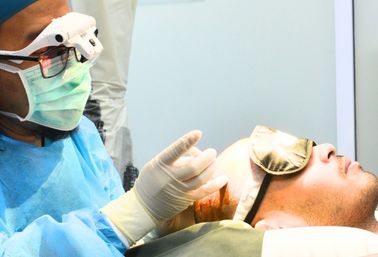
DHI / GII Hair Transplant: Advanced Graft Implantation for Precise Hair Restoration
Direct Hair Implantation (DHI) is one of the most discussed techniques in modern hair restoration. It is often presented as a distinct type of hair transplant, although technically, the implantation process is more accurately classified as Graft Insertion using an Implanter (GII).
At Dr Ruz Hair Transplant, we provide DHI/GII hair restoration using specialised implanter devices to give the surgeon precise control over graft placement, direction, angle, and depth.
Unlike conventional hair transplant techniques where the recipient sites are created first and grafts are then inserted with forceps, DHI/GII combines these two steps into one movement. A hollow, beveled needle creates the recipient opening while the graft is delivered through the same device.
As a result, the technique can provide excellent control when placing hair grafts, particularly in areas where angle, direction, and density are especially important.
However, the device itself is only one part of a successful hair transplant. Graft quality, donor management, surgical planning, hairline design, implantation technique, and long-term hair restoration strategy all matter.
Therefore, Dr Ruz approaches DHI/GII as part of a complete hair restoration plan rather than simply as a device-based procedure.
What Is DHI Hair Transplant?
DHI stands for Direct Hair Implantation. In practical terms, it describes the use of a specialised pen-like implanter to place individual follicular unit grafts directly into the recipient area.
Technically, this process is known as Graft Insertion using an Implanter (GII).
The device contains a hollow needle. The extracted hair graft sits inside this needle before implantation. When the surgeon positions the implanter against the scalp, the needle penetrates the recipient area at the planned angle and depth.
At the same time, the surgeon activates the plunger. The internal rod then pushes the graft out of the needle as the needle withdraws.
Consequently, the recipient opening and graft insertion happen almost simultaneously.
This differs from a conventional “stick-and-place” approach. With traditional placement, the surgeon or technician may first create recipient sites using blades or needles. The grafts are then placed into those openings with fine forceps.
By comparison, DHI/GII gives the surgeon direct control over both the creation of the recipient site and the insertion of the graft.
At Dr Ruz Hair Transplant, we use DHI/GII where it is appropriate for the patient’s hair characteristics, donor supply, restoration goals, and recipient area.
How Does a DHI Implanter Work?
The DHI/GII implanter looks relatively simple from the outside. Nevertheless, it is a carefully designed surgical instrument.
The device normally consists of:
- An ergonomic plastic or metal housing
- A hollow surgical steel needle
- A grooved channel within the needle
- An internal implanting rod
- A spring-loaded plunger mechanism
Furthermore, the needle is selected according to the characteristics of the graft being implanted.
Follicular units can contain different numbers of hairs. A follicular unit may contain one, two, three, or sometimes more hairs. Therefore, the implanter size must match the graft as closely as possible.
DHI Implanter Needle Sizes
The commonly used needle sizes include:
- 1-hair grafts: 0.6 mm to 0.8 mm needles, including 22-gauge sizes
- 2-hair grafts: 0.8 mm to 1.0 mm needles, including 20-gauge sizes
- 3-hair grafts: 1.0 mm to 1.2 mm needles, including 18-gauge sizes
This matching process is important because the graft needs to pass through the needle without excessive compression or resistance.
At the same time, the needle needs to be appropriate for the recipient site being created.
Therefore, DHI is not simply a matter of loading hair into a pen and pressing a button. It requires careful graft selection, loading, alignment, and placement.
What Types of DHI Implanters Are Used?
Several implanter systems have been developed for graft implantation.
Examples include the Choi, KNU, Hwang, Lion, and Follipen implanters.
Although their designs may differ, they share the same fundamental concept. The graft sits inside a hollow needle, while an internal rod and plunger mechanism allow the surgeon to deliver it into the scalp.
Importantly, the surgeon still controls the critical variables.
These include:
- Implantation angle
- Implantation direction
- Implantation depth
- Graft selection
- Placement location
- Density
- Hairline orientation
Consequently, the quality of the result depends heavily on surgical judgement and technical experience.
How Is a DHI / GII Hair Transplant Performed?
The DHI implantation stage begins after the follicular unit grafts have been extracted and prepared.
At Dr Ruz Hair Transplant, the overall treatment plan is designed around the patient’s donor area, hair loss pattern, existing hair, scalp characteristics, and desired restoration.
1. Preparing the Grafts
Once the follicular units have been extracted, the grafts are examined and organised according to their characteristics.
The surgical team identifies the number of hairs contained in each graft. This helps determine which implanter needle is appropriate.
For example, a one-hair graft requires a different needle size from a three-hair graft.
Moreover, grafts need to remain hydrated and protected throughout the procedure.
2. Loading the Implanter
A dedicated surgical technician, sometimes referred to as the loader, places the graft into the hollow implanter needle.
Fine jeweller’s forceps are used for this process.
However, the handling technique is extremely important. The loader should grasp the upper hair shaft rather than compressing the follicular structures around the bulb or the bulge area.
This approach helps reduce unnecessary mechanical trauma to the graft.
3. The Advantage of Longer Donor Hair
DHI can also benefit from leaving the donor hair slightly longer.
A hair length of approximately 5 to 10 mm can make graft loading easier. It also helps the surgical team identify the graft, count the hairs within the follicular unit, and maintain correct alignment.
Therefore, leaving the donor hair slightly longer can support more controlled graft preparation.
However, the ideal approach depends on the patient’s hair characteristics and the surgical plan.
How Is the Graft Implanted?
Once the graft has been loaded, the surgeon positions the implanter against the recipient scalp.
The needle is then introduced at the planned angle.
Typically, implantation occurs at approximately 45 to 70 degrees, although the exact angle depends on the treatment area and the natural direction of the patient’s existing hair.
Next, the surgeon advances the needle to the appropriate depth.
The plunger is then depressed. This moves the internal implanting rod forward and pushes the graft toward the base of the recipient site.
At the same time, the hollow needle withdraws.
As a result, the graft remains positioned beneath the skin surface, with the hair emerging in the intended direction.
This coordinated movement is one of the key features of DHI/GII.
Why Are Angle and Direction So Important?
Natural-looking hair restoration is not simply about putting more hair onto the scalp.
Instead, the surgeon must reproduce the direction and orientation of natural hair growth.
This becomes particularly important around the frontal hairline, temples, and eyebrows.
For instance, frontal hairs generally grow at a relatively low angle and follow a carefully controlled directional pattern. If grafts are placed too upright or in inconsistent directions, the result may look unnatural.
Therefore, DHI/GII gives the surgeon an opportunity to control these variables during implantation.
The surgeon can also rotate the needle during insertion when required. This can help align the graft with the natural curl of the hair shaft and the anterior orientation of the sebaceous gland.
Such details become especially relevant when working in delicate or cosmetically sensitive areas.
DHI Team Workflow and Implantation Speed
A well-organised DHI surgical team can maintain a continuous workflow between graft preparation and implantation.
For high-efficiency procedures, approximately 3 to 7 implanters may circulate continuously between the loader and surgeon.
This arrangement allows the surgeon to continue implanting while prepared grafts are supplied by the loading team.
With an experienced team and suitable conditions, implantation speeds can reach approximately 10 to 12 grafts per minute, or around 1,000 grafts per hour.
Nevertheless, speed should never become the primary goal.
Hair transplant surgery is a precision procedure. Protecting grafts, maintaining correct placement, and preserving the donor area remain more important than simply increasing the number of grafts implanted per hour.
At Dr Ruz Hair Transplant, the focus is therefore on controlled, precise implantation rather than treating speed as a measure of quality.
What Are the Advantages of DHI / GII?
DHI/GII can offer several technical advantages when performed correctly.
1. Reduced Mechanical Handling of the Graft
During conventional graft placement, forceps are used to transfer the graft into an existing recipient opening.
With DHI/GII, the graft remains inside the implanter needle during insertion.
Consequently, the graft is enclosed within the metal needle cylinder while it enters the recipient area.
This can reduce certain types of mechanical handling, including unnecessary squeezing, bending, or crushing of the graft.
However, graft protection still depends on careful extraction, loading, hydration, handling, and implantation.
2. Simultaneous Site Creation and Graft Placement
One of the defining features of DHI/GII is that the recipient site is created as the graft is inserted.
Therefore, there is no need to create a large number of empty recipient sites in advance.
This may reduce some of the practical challenges associated with open recipient sites.
For example, an empty incision can potentially bleed or develop a fibrin clot before the graft is inserted.
With DHI, the graft enters the site immediately.
3. Better Control of Recipient Placement
Because the surgeon controls the implanter directly, the technique can provide precise control over where the graft is placed.
This is particularly useful when working around the frontal hairline, temples, or areas where existing hair must be preserved.
Furthermore, the surgeon can adjust the angle and direction of individual grafts according to the surrounding hair pattern.
4. Fewer Placement Errors
The combined opening-and-placement process can also help reduce certain common placement problems.
These include:
- Missed sites, where an incision is created but a graft is not inserted
- Piggybacking, where two grafts accidentally enter the same opening
- Popping, where neighbouring grafts become displaced because of tissue pressure
DHI does not eliminate every surgical risk. However, its implantation mechanism can reduce some of these practical problems.
Can DHI Create High-Density Hair Transplants?
Yes, DHI can be used for high-density implantation.
Reported implantation densities can range from approximately 30 to 40 follicular units per cm², with densities reaching up to 80 follicular units per cm² in selected situations.
However, higher density does not automatically mean a better hair transplant.
The scalp has a vascular supply that must support the implanted follicles and surrounding tissue. Therefore, the surgeon must consider tissue characteristics, existing hair, recipient-site spacing, graft quality, and the patient’s individual circumstances.
For that reason, density should always be planned rather than maximised blindly.
A natural hairline may also require a different density from the central scalp.
At Dr Ruz Hair Transplant, DHI/GII implantation is planned around the overall appearance of the hair rather than a single density number.
DHI vs Traditional Hair Transplant Placement
Patients often ask whether DHI is better than other hair transplant techniques.
The answer is more nuanced.
DHI/GII is primarily an implantation method. FUE, meanwhile, describes a method of extracting individual follicular units from the donor area.
Therefore, a patient can undergo FUE extraction followed by DHI/GII implantation.
These techniques are not necessarily competing procedures.
Instead, they can work together.
For example, follicular units may be individually extracted from the donor area using FUE. The selected grafts can then be prepared and loaded into DHI implanters before being placed into the recipient area.
Consequently, an FUE hair transplant with DHI/GII implantation can combine precise extraction with controlled graft insertion.
What Are the Limitations of DHI?
Despite its advantages, DHI is not suitable for every situation, and it has technical limitations.
Operator Experience Matters
DHI/GII requires direct physician control during graft implantation.
In some conventional hair transplant workflows, trained technicians may perform a significant part of graft placement. By contrast, needle implanter procedures require the physician to control the implantation process closely.
As a result, DHI can require greater physician involvement, intensive team training, and higher equipment costs.
The technique therefore depends heavily on the skill and experience of the operating surgeon.
Depth Control Is Critical
The surgeon must also control implantation depth carefully.
If the needle penetrates too deeply, or if the graft is pushed too far below the skin surface, complications such as epidermal cyst formation or cosmetically undesirable pitting can occur.
Modern implanters may incorporate depth-control stoppers or customised needle sleeves.
These features can help prevent excessive penetration.
Even so, technology cannot replace surgical judgement. The surgeon still needs to understand scalp thickness, tissue resistance, graft size, and the correct implantation depth.
Needles Can Become Dull
Repeated needle penetration can gradually dull the implanter.
This can become more noticeable when working with firm or fibrotic scalp tissue.
A dull needle may increase resistance during insertion and can contribute to graft displacement or popping.
Therefore, needles need to be monitored and replaced periodically throughout surgery when necessary.
Maintaining sharp, suitable instruments is another part of protecting the quality of the procedure.
How Does Hair Type Affect DHI?
Hair characteristics can influence the DHI technique.
DHI implanters are particularly popular in Asian populations where hair is often relatively thick and straight.
However, patients from other ethnic backgrounds can also undergo DHI/GII.
Caucasian and curly hair can present different technical considerations. Finer or splayed hair shafts may bend during loading.
Similarly, curly grafts may require rotational adjustment to follow their natural orientation.
Therefore, the loading and implantation technique may need to change according to the patient’s hair characteristics.
This is one reason why a personalised approach matters.
The surgeon must understand not only how many grafts are available but also how those grafts behave during extraction, preparation, loading, and implantation.
Is DHI Suitable for Everyone?
DHI/GII may be suitable for many patients seeking hair restoration, but it should not automatically be considered the best option for everyone.
The appropriate technique depends on several factors, including:
- The pattern and severity of hair loss
- Donor hair density
- Donor area characteristics
- Hair calibre
- Hair curl and texture
- Existing hair in the recipient area
- Desired density
- Hairline design
- Size of the restoration area
- Previous hair transplant surgery
- Long-term hair loss progression
Furthermore, the patient’s future hair loss matters.
A hair transplant should not only address the hair that is missing today. It should also consider what may happen to the patient’s native hair over time.
That is why proper assessment and long-term planning are essential.
DHI / GII at Dr Ruz Hair Transplant
At Dr Ruz Hair Transplant, DHI/GII forms part of a broader approach to modern hair restoration.
The objective is not simply to insert grafts using an implanter.
Instead, the procedure should create a result that works with the patient’s existing hair, facial proportions, donor supply, and future restoration needs.
Dr Ruz provides DHI/GII hair implantation for suitable patients, using specialised implanter technology to control graft placement, angle, direction, and depth.
At the same time, attention is given to graft handling before implantation.
This includes careful preparation, appropriate graft selection, suitable needle sizing, and controlled loading.
Moreover, the implantation strategy can be adjusted according to the treatment area.
The frontal hairline, temples, mid-scalp, crown, and eyebrow region can all require different approaches.
Therefore, a single standardised implantation pattern does not suit every patient.
Why Long-Term Planning Matters in Hair Restoration
A successful hair transplant should look natural not only immediately after surgery but also as the patient’s hair changes over time.
Existing native hair may continue to thin. Meanwhile, transplanted follicles are generally selected from areas considered more resistant to androgenetic hair loss, but donor hair is not an unlimited resource.
Consequently, donor preservation remains an important part of treatment planning.
The number of grafts available, the distribution of donor hair, and the patient’s expected future needs should all influence the restoration strategy.
DHI/GII can provide precise implantation, but it cannot create additional donor hair.
Therefore, the technique works best when combined with careful diagnosis, realistic expectations, donor management, and appropriate long-term hair loss treatment when indicated.
DHI Is About Precision, Not Just a “Hair Transplant Pen”
Online marketing sometimes makes DHI sound like a simple automated procedure.
In reality, the implanter is a surgical instrument.
Its performance depends on the person using it.
The surgeon must understand follicular anatomy, hair direction, scalp tissue, graft characteristics, implantation depth, density, and the relationship between the transplanted and existing hair.
Furthermore, the surgical team must handle each graft carefully before it ever reaches the implanter.
Therefore, the technology should be viewed as a tool that can improve control rather than as a replacement for surgical expertise.
The Bottom Line: Is DHI/GII Right for You?
DHI, technically described as Graft Insertion using an Implanter (GII), is an advanced graft implantation technique used in modern hair restoration.
It combines recipient-site creation and graft insertion into a coordinated movement using a hollow, beveled needle and internal plunger.
As a result, it can provide precise control over graft placement, angle, direction, and depth.
The technique can also support dense implantation, reduce certain forms of graft handling, and help minimise problems such as missed sites, piggybacking, and graft popping.
Nevertheless, DHI is not simply about using a specialised pen.
The quality of a hair transplant depends on the complete process, from diagnosis and donor planning through FUE extraction, graft preparation, loading, implantation, and long-term follow-up.
At Dr Ruz Hair Transplant, we provide DHI/GII hair restoration as part of a personalised approach to hair transplantation.
If you are considering a DHI hair transplant, the most important question is not simply whether the clinic offers an implanter.
Instead, ask how the surgeon plans your donor area, designs your hairline, selects and handles your grafts, determines implantation density, and protects your long-term hair restoration potential.
Ultimately, the goal is simple: to restore hair in a way that looks natural, fits your facial features, protects valuable donor hair, and supports your long-term hair restoration plan
- Device Design: The implanter device consists of an ergonomic plastic or metal housing, a hollow surgical steel needle with a grooved channel, an internal implanting rod, and a spring plunger.
- Gauge & Color-Coded Needle Sizes: Implanter needles are color-coded and matched precisely to the hair count and caliber of each individual follicular unit (FU) graft:
- 1-Hair Grafts: Delivered using 0.6 mm to 0.8 mm (22-gauge) needles.
- 2-Hair Grafts: Delivered using 0.8 mm to 1.0 mm (20-gauge) needles.
- 3-Hair Grafts: Delivered using 1.0 mm to 1.2 mm (18-gauge) needles.
- Graft Loading: A dedicated surgical technician (the “loader”) preloads extracted grafts into the hollow implanter needle using fine jeweler’s forceps. To avoid damaging the vital stem cells in the bulge area or hair bulb, the loader grasps only the upper hair shaft.
- Long Hair Advantage: Leaving donor hair slightly long (5 to 10 mm) greatly facilitates atraumatic graft loading, precise follicle counting, and correct alignment.
- Insertion Mechanism: The physician pierces the recipient scalp at the desired angle (typically 45 to 70 degrees) to full depth and depresses the plunger. While the plunger holds the internal rod against the graft base, the hollow needle is automatically withdrawn, leaving the graft neatly tucked underneath the skin flush with the surface.
- Rotation & Directional Control: For delicate areas such as the frontal hairline or eyebrows, the physician can rotate the needle during insertion to align the natural curl of the hair shaft and the anterior orientation of the sebaceous gland.
- Team Circulation: High-efficiency teams utilize 3 to 7 implanters in continuous circulation between the loader and surgeon, enabling implantation speeds of 10 to 12 grafts per minute or 1,000 grafts per hour.
- Follicular Protection: Because the graft is entirely encased and protected inside the metal needle cylinder during insertion, physical trauma—such as crushing, bending, or squeezing by forceps—is minimized.
- Hemostasis & Bleeding Reduction: Because the graft fills the micro-incision immediately upon creation, there is no time gap where an open site can bleed or form fibrin clots.
- Elimination of Common Pitfalls: Simultaneously opening the skin and placing the graft eliminates “missed sites” (lost incisions), “piggybacking” (accidental double insertion into one hole), and “popping” (neighbouring grafts lifting out due to tissue pressure).
- High Density: DHI permits dense packing (30 to 40 FUs/cm² up to 80 FUs/cm²) while preserving vascular supply.
- Operator Dependent: Unlike standard placement which is performed largely by technicians, needle implanter procedures require direct physician placement, leading to higher equipment costs and requiring intensive team training.
- Pitting & Depth Control: If the needle is inserted too deeply, or if the graft is pushed below the skin surface, epidermal cysts or cosmetically unnatural “pitting” can occur. Modern implanters incorporate depth-control stoppers or custom needle sleeves to prevent over-penetration.
- Needle Dulling: Needles can dull after repeated scalp penetrations (especially in firm or fibrotic tissue) and must be periodically replaced during surgery to avoid graft popping.
- Hair Texture Variations: DHI implanters are highly popular in Asian populations with thick, straight hair. In Caucasian or curly hair, finer or splayed shafts can occasionally bend during needle loading or require rotational adjustment.