
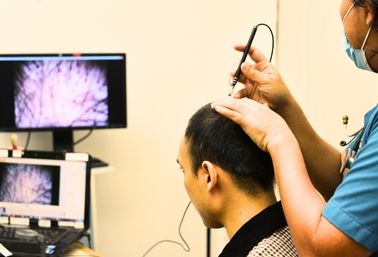
- Bandaging & Protection: In standard surgical protocols, a turban-like or absorbent gauze dressing is applied overnight to absorb minor bleeding and keep grafts secure, then removed on postoperative day 1. Alternatively, some surgeons employ non-occlusive Telfa pads, paper caps, or loose bandanas, while others leave the recipient area completely unbandaged to prevent friction.
- Gentle Cleansing & Hydration: Hair washing is restricted during the first 24 to 48 hours to prevent accidental graft dislodgement. Beginning on postoperative day 1 or 2, the scalp is gently washed using a mild, pH-neutral or baby shampoo, using the flats of the fingers with light dabbing rather than aggressive rubbing or towel friction. Rinsing or spraying the recipient area with thermal water or sterile saline 8 to 10 times daily during the first 6 days keeps grafts hydrated and accelerates recovery.
- Crust & Scab Removal: Micro-crusts and scabs form within 24–48 hours and typically fall off spontaneously between days 7 and 13. Soaking the scalp with warm compresses prior to showering after day 7 assists in autolytic debridement. Forcible scratching, picking, or scraping of scabs must be strictly avoided.
- Sleeping Position: Facial and forehead edema commonly appears on postoperative day 2 or 3 and lasts 3 to 7 days. To encourage fluid drainage, patients should sleep with the head elevated at a 45-degree angle or in a semi-supine position for the first week. Using a specialized neck pillow prevents the recipient site from coming into direct contact with bed linens. Lying on the donor site is permitted, but pressure on recipient grafts should be avoided for 1 to 2 weeks.
- Mechanical & Thermal Barriers: Applying ice packs to the forehead (never directly on recipient grafts) and wearing a snug forehead elastic headband or sports band for 3 to 5 days creates a mechanical barrier that minimizes downward periorbital swelling (“black eyes”).
- Analgesics: Postoperative pain is usually mild and limited to the donor region on the evening of surgery. Mild analgesics such as acetaminophen/paracetamol, short-course NSAIDs (e.g., ibuprofen 600 mg), or mild opioids are utilized as needed. Aspirin and unprescribed blood thinners are strictly avoided due to bleeding risks.
- Anti-Inflammatory Corticosteroids: Tapering schedules of systemic oral corticosteroids (e.g., prednisone) or short courses of prednisolone/dexmedetomidine are routinely prescribed to control tissue edema and donor site inflammation.
- Antibiotics & Topical Gels: Short prophylactic courses of oral antibiotics (e.g., cephalosporins) along with topical ointments (such as bacitracin) or healing gels (such as Bepanthen scar gel or panthenol) are applied to the donor wound for 1 week.
- Medical Therapy for Hair Loss:
- Topical Minoxidil (3% or 5%): Resuming or starting topical minoxidil 5 to 7 days (or 1–2 weeks) post-surgery—once recipient epithelium has healed—reduces postoperative effluvium (“shock loss”) and promotes faster graft regrowth.
- Oral Finasteride (1 mg daily): Finasteride can be continued uninterrupted throughout the surgical period to protect preexisting, non-transplanted native hair from ongoing androgenetic alopecia.
- Physical Exertion & Exercise: Heavy physical labor, body-building, or activities causing heavy sweating and blood pressure spikes are restricted for 1 to 2 weeks. Low-impact exertion and gentle swimming may resume around day 3 to 7.
- Work Convalescence: Taking 3 to 7 days (and up to 10 days for physically demanding labor or strict privacy requirements) off work is recommended.
- Environmental Exposure: Refrain from visiting saunas, solariums, direct sun exposure, or tanning beds for at least 3 to 4 weeks. Direct contact with rain, heavy dust, or dirt should be avoided for 1 month.
- Headwear, Hairpieces & Chemical Treatments: Hair coloring, perming, or chemical straighteners should be delayed for at least 2 weeks or until all crusts have completely resolved. Hairpieces or toupees should not be worn for at least 3 to 5 days to 2 weeks to prevent friction and infection. Loose-fitting baseball caps or unbuttoned front shirts are recommended over tight beanies when traveling post-op.
- Weeks 2–4 (Shedding Phase / Shock Loss): The majority of transplanted hair shafts shed between 2 and 4 weeks post-surgery. Temporary shedding of preexisting native hairs in the recipient or donor area (“shock loss”) may also occur due to local surgical stress, returning 2 to 4 months later.
- Months 3–4 (Sprouting Phase): Transplanted hair roots re-enter the anagen (growth) phase, and new fine permanent hair begins to sprout from the scalp.
- Months 6–12+ (Maturation): Substantial cosmetic improvements become visible by month 6, with full growth, maximum density, and complete shaft adaptation reached between 9 and 12 months (or up to 18 months).
- Sensory Recovery & Folliculitis: Temporary numbness (hypoesthesia) in the donor or frontal region typically resolves spontaneously over 3 to 6 months. Mild superficial pustules or sterile folliculitis appearing in weeks 2 to 4 as new hairs emerge are treated with warm compresses, gentle needle drainage, or topical/oral antibiotics if infected.
Hair Transplant and Restoration Aftercare by Dr Ruz: Your Complete Guide to Recovery, Hair Growth and Long-Term Results
A hair transplant is an important step towards restoring your hair and confidence. However, the procedure itself is only part of the journey. What you do after a hair transplant can also affect how comfortably you recover, how well your scalp heals, and how your final hair restoration results develop.
For this reason, hair transplant aftercare should never be treated as an afterthought.
After surgery, your newly transplanted grafts need time to settle. Your scalp also needs time to heal. Meanwhile, the existing hair around the transplanted area may continue to be affected by hair loss.
At Dr Ruz Hair Transplant, we look at hair restoration as a long-term process rather than a single procedure. The goal is not simply to place grafts into areas of thinning hair. Instead, we focus on protecting the transplanted follicles, monitoring your recovery, supporting healthy hair growth, and helping you maintain your results over time.
That is why follow-up care is an important part of our approach.
Depending on your individual needs, Dr Ruz can continue monitoring your progress for up to 18 months after your hair transplant. During this period, your recovery and hair growth can be assessed, and appropriate treatments can be recommended when necessary.
So, what should you expect after a hair transplant?
What Happens After a Hair Transplant?
The first few days after a hair transplant are mainly about protecting the scalp and allowing the transplanted grafts to settle.
You may notice mild redness, tightness, swelling, tenderness, or small crusts around the treated areas. These are generally normal parts of the early recovery process.
However, recovery does not stop after the first week.
During the following weeks and months, the transplanted hair goes through several stages. Some transplanted hair shafts may shed. Existing hair can temporarily become thinner. New hair growth then gradually begins, followed by a longer period of thickening and maturation.
Because everyone heals at a different rate, your recovery timeline may not be exactly the same as someone else’s.
For that reason, follow your personalised instructions from Dr Ruz rather than relying only on general advice found online.
1. Protect Your Scalp During the First Few Days
The first 24 to 48 hours are particularly important.
Freshly transplanted grafts need gentle handling while they become secure within the recipient area. Therefore, avoid touching, scratching, rubbing, or pressing the transplanted area unless you have been specifically instructed to do so.
Depending on the surgical technique and your individual case, your scalp may have a light dressing or may be left uncovered. Your doctor will advise you on the appropriate approach.
In addition, avoid unnecessary contact with hats, helmets, pillows, clothing, or anything else that could rub against the newly transplanted grafts.
During this early stage, less is often more.
You do not need to constantly touch your scalp to check whether the grafts are still there. Instead, allow the area to settle and follow the post-operative instructions provided by the clinic.
2. How to Wash Your Hair After a Hair Transplant
Many patients worry about washing their hair after a hair transplant. That concern is understandable, but gentle scalp hygiene is an important part of recovery.
Generally, patients are advised to avoid normal vigorous hair washing during the first day or two. After that, washing can usually begin according to the specific instructions provided by the surgical team.
Use a mild shampoo and lukewarm water unless Dr Ruz recommends another product.
Most importantly, do not aggressively rub the recipient area.
Instead, use the flats of your fingers and gentle movements. Avoid using your fingernails. Likewise, do not scrub away crusts or use a rough towel on the scalp.
After washing, allow the scalp to dry gently or pat it carefully with a clean, soft towel if advised.
During the early healing period, keeping the scalp clean without disturbing the grafts is the goal.
Some patients may also be advised to use sterile saline or another recommended spray to keep the recipient area appropriately hydrated during the initial recovery period.
However, the exact frequency and method should follow your clinic’s instructions.
3. Do Not Pick Scabs or Crusts
Small crusts commonly appear around transplanted grafts during the first several days.
They can look alarming, particularly when you are eager to see your new hair. Nevertheless, these crusts are a normal part of the healing process.
In many cases, they gradually loosen and fall away naturally during the first one to two weeks.
Do not scratch, pick, scrape, or forcibly remove them.
Instead, follow the washing instructions provided by Dr Ruz. Once the scalp has reached the appropriate stage of healing, gentle washing can help loosen remaining crusts.
Trying to remove them too early can irritate the scalp and may interfere with the healing process.
Therefore, patience is an important part of hair transplant aftercare.
4. Sleep Carefully After Your Hair Transplant
Swelling can occur after hair transplant surgery. It commonly becomes more noticeable around the forehead or face a few days after the procedure.
Although this can look dramatic, it is often temporary.
To help minimise swelling, patients may be advised to sleep with the head elevated during the first several nights. A semi-upright position can encourage fluid to move away from the forehead.
A suitable travel or neck pillow can also help you avoid accidentally pressing the recipient area against the bed.
Meanwhile, try not to sleep directly on freshly transplanted grafts.
Your doctor may allow you to sleep on the donor area, depending on your procedure and recovery. However, pressure on the recipient area should generally be avoided during the early healing stage.
If swelling occurs, follow the specific instructions provided by Dr Ruz. Cold packs may sometimes be used around the forehead, but they should not be placed directly over transplanted grafts unless specifically instructed.
5. Managing Pain, Swelling and Medication
Most patients experience relatively mild discomfort after hair transplant surgery. The donor area can feel sore, tight, or sensitive during the first few days.
Your doctor may recommend suitable pain relief based on your medical history and individual circumstances.
Likewise, medication may sometimes be prescribed to manage inflammation, swelling, or other aspects of recovery.
However, there is no single medication plan that is suitable for every patient.
For example, antibiotics are not automatically required for everyone, while anti-inflammatory medication may also depend on your procedure and medical history.
Therefore, take only medication recommended or approved by your doctor.
You should also tell Dr Ruz about any medication, supplements, allergies, or medical conditions before surgery. In particular, do not stop or restart prescription medication on your own.
The same principle applies to hair-loss treatments.
6. Should You Use Minoxidil or Finasteride After a Hair Transplant?
Hair transplant surgery restores hair to areas affected by thinning or baldness. However, it does not necessarily stop the underlying process of androgenetic hair loss.
This distinction is important.
Your transplanted follicles may be resistant to the effects of hair loss, but the non-transplanted hair surrounding them may continue to thin over time.
For this reason, medical hair-loss treatment may be appropriate for some patients.
Minoxidil can support hair growth in suitable patients, while finasteride may help reduce the progression of male pattern hair loss in appropriate candidates.
However, the decision to start, stop, or restart these treatments should be individualised.
Some patients may already use hair-loss medication before their procedure. Others may benefit from treatment after surgery. Timing can also depend on how quickly the recipient area heals.
Dr Ruz can assess your scalp and overall hair-loss pattern before recommending an appropriate treatment plan.
This is an important part of long-term hair restoration because the objective is not only to grow transplanted hair. It is also to protect the surrounding native hair where possible.
7. Avoid Heavy Exercise During Early Recovery
Exercise is healthy, but immediately after a hair transplant, your body needs time to recover.
Heavy exercise can increase sweating, blood pressure, and physical strain. Consequently, strenuous workouts, heavy lifting, bodybuilding, and physically demanding activities are usually restricted during the early recovery period.
The exact timeframe depends on your procedure and recovery.
Light activity may be possible sooner, while strenuous exercise generally needs to wait longer.
Swimming, for example, may need to be avoided during the early healing period because pools and other water environments can expose healing skin to irritation or microorganisms.
Instead of rushing back into your normal training routine, gradually return to exercise when your doctor confirms that it is appropriate.
Your hair restoration journey is measured in months, so there is little benefit in taking unnecessary risks during the first few days.
8. Protect Your Scalp From Sun, Heat and Environmental Irritants
Your scalp can remain sensitive after a hair transplant.
Therefore, direct and prolonged sun exposure should be avoided during the early healing period. Excessive heat, tanning beds, and similar exposures can irritate healing skin.
Dust and dirt can also be problematic, particularly if you work outdoors or in a dusty environment.
For this reason, patients should follow Dr Ruz’s advice regarding when it is safe to return to specific work environments.
If you need to wear a hat, helmet, or other headwear, ask your surgical team when it is safe to do so and which type is appropriate.
A loose-fitting option may be preferable during the early recovery period when headwear is permitted.
9. When Can You Return to Work?
The answer depends largely on your type of work and how comfortable you feel.
Someone working from home may return to normal activities sooner than someone working outdoors or performing heavy physical labour.
Many patients choose to take several days away from work. Others may prefer a longer period for privacy or comfort.
Visible redness, small crusts, and swelling can temporarily make the procedure noticeable. These signs usually improve as healing progresses.
Consequently, planning a few days away from work can make the recovery period more comfortable.
Before returning, consider your working environment as well as your job duties. If your work involves heavy lifting, heat, dust, helmets, or significant sweating, speak with Dr Ruz about your individual timeline.
10. When Can You Cut, Colour or Style Your Hair?
Hair styling should be approached gently after a hair transplant.
During the early healing period, avoid unnecessary manipulation of the recipient area. Chemical treatments such as colouring, perming, or straightening should also be delayed until the scalp has healed sufficiently.
Your doctor can tell you when it is safe to resume these activities.
Likewise, avoid tight hairstyles or anything that pulls on the scalp.
The important principle is simple: do not put unnecessary stress on healing skin or newly transplanted follicles.
11. Understanding Hair Transplant Shock Loss
One of the most stressful parts of hair transplant recovery is shedding.
Some patients expect their transplanted hair to continue growing immediately after surgery. Instead, many transplanted hair shafts shed during the first few weeks.
This is commonly known as shock loss or postoperative shedding.
It can feel disappointing, especially after investing time and money into hair restoration. However, shedding does not necessarily mean that the transplant has failed.
The transplanted follicle can remain beneath the skin even when the visible hair shaft falls out.
Temporary shedding can also affect some existing native hairs around the treatment area.
The good news is that new growth can gradually emerge as the follicles enter a new growth cycle.
If you experience significant or unexpected hair loss, contact your clinic rather than assuming that something has gone wrong.
12. Your Hair Transplant Growth Timeline
Hair growth after a transplant takes time.
Understanding the timeline can help you manage expectations and avoid unnecessary worry.
First week
During the first week, the focus is primarily on healing and protecting the grafts.
Redness, mild swelling, sensitivity, and small crusts can occur. Your scalp may not look the way you expected yet.
That is completely normal.
Week 2 to Week 4
The visible transplanted hair may begin to shed.
This stage can be emotionally challenging because your hair may appear thinner than shortly after surgery. However, the follicles can remain in place beneath the skin.
At this point, the goal is patience.
Months 2 to 3
The scalp gradually moves beyond the initial healing stage.
Some patients may notice early changes, while others may see very little visible growth. Hair growth does not happen at exactly the same speed for everyone.
Therefore, do not compare your progress too closely with photographs from other patients.
Months 3 to 6
New transplanted hairs may begin to appear.
Initially, these hairs can be fine, soft, or lighter than expected. Gradually, they can become stronger and more visible.
This is when many patients begin to notice meaningful improvement.
Months 6 to 12
Hair density and coverage usually continue improving.
The transplanted hairs mature, become thicker, and blend more naturally with surrounding hair.
At this stage, photographs taken at different points during recovery can be particularly useful. They allow you and your doctor to compare progress objectively rather than relying only on memory.
Months 12 to 18
Hair restoration does not necessarily finish at the one-year mark.
Some patients continue to experience maturation and thickening beyond 12 months. In certain cases, the final appearance can continue developing for up to 18 months.
That is why long-term follow-up matters.
13. Why Follow-Up Matters After a Hair Transplant
A hair transplant should not be viewed as a procedure where you have surgery and then simply wait for the result.
Your scalp changes throughout the recovery process.
Your native hair may also change.
Furthermore, your response to supportive treatments can change over time.
At Dr Ruz Hair Transplant, follow-up is therefore an important part of the overall hair restoration journey.
Depending on your individual case, Dr Ruz can monitor your progress through the healing, shedding, early growth, thickening, and maturation stages.
Follow-up may continue for up to 18 months.
During these appointments, your doctor can assess the condition of your scalp, the development of transplanted hair, the appearance of surrounding native hair, and your overall progress.
If additional treatment is appropriate, it can also be considered based on your individual needs.
This may include medical hair-loss treatment or other supportive approaches designed to help maintain healthy hair growth.
The advantage is that your treatment plan can evolve with you.
Instead of receiving generic advice and being left to manage the rest alone, you have professional guidance throughout the most important stages of your hair restoration journey.
14. Hair Restoration Is About More Than Transplanted Grafts
A successful hair transplant is not simply about the number of grafts placed into the scalp.
Natural-looking hair restoration also depends on factors such as hairline design, graft placement, donor supply, existing native hair, hair characteristics, healing, and long-term hair-loss progression.
That is why maintenance matters.
Imagine having excellent transplanted hair but gradually losing the surrounding native hair. The result could eventually look less balanced.
By contrast, a carefully planned long-term approach considers both transplanted and existing hair.
Consequently, Dr Ruz’s follow-up approach focuses on the bigger picture.
The aim is to help you achieve a natural-looking result that continues to look appropriate as your hair matures and your overall hair-loss pattern develops.
15. When Should You Contact Your Hair Transplant Clinic?
Most postoperative symptoms are temporary and manageable. Nevertheless, you should contact your clinic if something seems unusual or significantly worse than expected.
Seek medical advice if you develop severe or increasing pain, significant bleeding, spreading redness, fever, substantial swelling, pus, or other symptoms that concern you.
Similarly, contact your doctor if you are unsure whether a particular product, medication, exercise, or hair-care routine is safe.
It is always better to ask than to guess.
Your surgical team knows the details of your procedure and can provide advice based on your actual recovery.
Your Hair Transplant Is the Beginning, Not the End
Choosing a hair transplant is a major decision.
Naturally, you want the best possible result from your investment. However, achieving a good outcome is not simply about what happens on the day of surgery.
Hair transplant aftercare, scalp healing, hair-loss management, and long-term follow-up all play an important role.
The first days are about protecting the grafts.
The following weeks are about healing and managing expectations.
The next few months are about waiting patiently for new growth.
Then, as the transplanted hair matures, your focus shifts towards maintaining your overall hair.
At Dr Ruz Hair Transplant, we believe patients deserve support throughout that journey.
That is why follow-up can continue for up to 18 months. During this period, Dr Ruz can monitor your hair growth and recovery and recommend appropriate treatments when needed.
The purpose is simple: to help make your hair restoration results as healthy, natural-looking, and sustainable as possible.
Your hair transplant may take only a day or a few hours to perform.
Your hair restoration journey takes much longer.
With proper aftercare, realistic expectations, professional monitoring, and an appropriate long-term treatment plan, you can give your transplanted hair the best opportunity to develop while also protecting the hair you already have.
If you are considering a hair transplant, speak with Dr Ruz about your hair loss, your goals, your donor area, and the type of long-term care that may be appropriate for you.
Because great hair restoration is not just about where the grafts are placed.
It is also about what happens after they are placed.