
Who Is Suitable for a Hair Transplant? Understanding Male Pattern Baldness Candidacy
Are You a Suitable Candidate for a Hair Transplant?
Is your hairline slowly moving backwards?
Perhaps your temples are becoming more visible. Maybe your crown looks thinner under bright light. Or you may have noticed that your hair no longer looks as dense as it did five or ten years ago.
For many men, these changes are signs of male pattern baldness.
However, noticing male pattern baldness does not automatically mean that you need a hair transplant.
That distinction is important.
A hair transplant can be an excellent solution for selected patients. Nevertheless, the procedure works best when your hair loss pattern, donor supply, scalp condition, general health, and expectations all support the treatment.
So, how do you know whether you are suitable?
At Dr. Ruz Hair Transplant, we believe the answer starts with understanding the reason behind your hair loss. Once we identify the cause, we can assess whether transplantation is appropriate for you.
Sometimes, the best first step is a hair transplant.
In other cases, medical treatment may be more appropriate.
Furthermore, some patients may benefit from stabilising their hair loss before considering surgery.
This guide explains the key factors we consider when assessing someone with male pattern baldness for a hair transplant.
What Is Male Pattern Baldness?
Before discussing suitability, it helps to understand what male pattern baldness actually means.
Male pattern baldness, also called androgenetic alopecia or male pattern hair loss, is the most common type of progressive hair loss in men.
Genetics and hormones both contribute to the condition.
In genetically susceptible men, certain hair follicles are more sensitive to the effects of dihydrotestosterone, commonly known as DHT.
Over time, affected follicles can gradually become smaller.
As this happens, the hairs they produce may become finer and shorter. Eventually, some follicles may produce little or no visible hair.
The process usually happens gradually rather than overnight.
You may first notice a small change at your temples. Later, the frontal hairline may recede further. Alternatively, thinning may begin around the crown.
Some men experience both.
This progression is why diagnosing the pattern of hair loss matters before considering a transplant.
A surgeon needs to know not only where you have lost hair, but also where you may lose hair in the future.
Why Male Pattern Baldness Is Often Suitable for Hair Transplantation
Male pattern baldness is one of the conditions that can respond well to hair transplantation.
The reason comes down to how the condition affects different parts of the scalp.
Hair at the back and sides of the head is often more resistant to the hormonal effects responsible for male pattern baldness.
These areas are known as the donor region.
During a hair transplant, suitable follicles can be taken from the donor area and moved to areas affected by hair loss.
The transplanted follicles can then continue growing in their new location.
However, this does not mean every man with male pattern baldness is automatically a candidate.
Your donor supply is limited.
Therefore, we need to determine whether you have enough healthy donor hair to achieve a meaningful and natural-looking result.
That is where individual assessment becomes essential.
1. You Have a Clear Diagnosis of Male Pattern Baldness
The first question is simple:
Why are you losing your hair?
Male pattern baldness may be the answer, but we should not assume it.
Hair loss can occur for many reasons.
For example, sudden shedding can have different causes from gradual recession at the temples. Likewise, patchy bald spots may indicate a condition that requires a completely different approach.
Therefore, a proper assessment should come before surgery.
When the pattern is consistent with male pattern baldness, transplantation may be considered if other factors are favourable.
Typical signs include:
- Receding temples.
- A gradually higher frontal hairline.
- Crown thinning.
- Progressive thinning across the top of the scalp.
- A family history of similar hair loss.
- Miniaturised hairs around areas of thinning.
Once the diagnosis is established, we can move on to the next question:
Is your hair loss suitable for restoration?
2. Your Hair Loss Is Stable Enough for Surgery
This is one of the most important considerations.
Imagine a man who has recently started experiencing rapid hair loss.
He undergoes a transplant immediately and receives a new frontal hairline.
However, his natural hair continues to recede behind the transplanted area.
A few years later, he may have transplanted hair at the front but significant thinning behind it.
That is not the long-term result we want.
Therefore, patients with rapidly progressing male pattern baldness may need medical management or observation before surgery.
Stabilising the hair loss can make long-term planning more predictable.
Depending on your individual situation, your doctor may discuss treatments such as minoxidil or finasteride.
These medications are not suitable for everyone, and they have different benefits, risks, and considerations. Consequently, you should discuss them with a qualified medical professional before starting treatment.
Interestingly, some men experience enough improvement from medical treatment that they decide to postpone a transplant.
For others, medical management helps preserve their existing hair while transplantation addresses areas where substantial loss has already occurred.
The best hair restoration plan protects both the hair you have lost and the hair you still have.
3. You Have Enough Healthy Donor Hair
Your donor area is arguably one of the most important factors in hair transplant suitability.
Think of your donor hair as a limited natural reserve.
A transplant does not give you an unlimited supply of new follicles.
Instead, it redistributes follicles from one area to another.
Therefore, a man with a dense donor area may have considerably more restoration options than someone with poor donor density.
During an assessment, we look at several characteristics.
These may include:
- Donor hair density.
- Hair shaft thickness.
- Follicular unit structure.
- Distribution of donor follicles.
- Miniaturisation within the donor region.
- Scalp characteristics.
- The size of the recipient area.
We also consider your likely future hair loss.
That last point matters.
A donor area that looks strong today may still need to support your future restoration needs.
Consequently, aggressive harvesting may not be appropriate.
A responsible treatment plan should preserve the appearance and health of your donor area while achieving the best possible improvement.
4. Your Male Pattern Baldness Is at a Treatable Stage
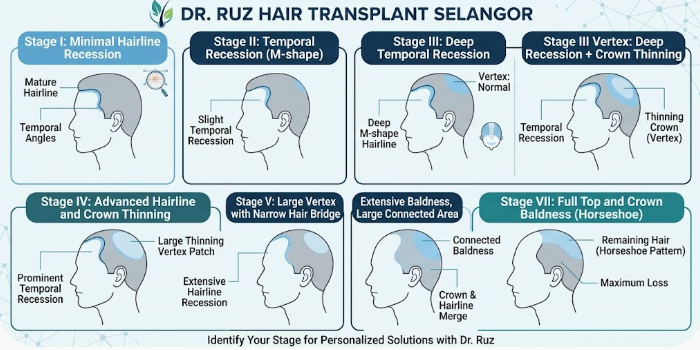
The Norwood Scale is commonly used to describe the progression of male pattern hair loss.
It ranges from minimal recession to advanced baldness.
However, your Norwood stage alone does not determine whether you are suitable for surgery.
For example, a man with moderate hairline recession and strong donor density may be an excellent candidate.
Meanwhile, another man at a similar stage may have weak donor density and limited options.
Therefore, the same Norwood stage can produce very different treatment plans.
Early Male Pattern Baldness
Early recession does not always require a transplant.
If you still have substantial native hair, medical management may be worth considering first.
This approach can help preserve your existing density and may delay the need for surgery.
Moderate Male Pattern Baldness
Men with more established recession or crown thinning may become stronger candidates.
At this stage, the pattern may be easier to understand, allowing a more predictable design.
Advanced Male Pattern Baldness
Advanced hair loss can still be treated in selected patients.
However, expectations become particularly important.
If the bald area is extensive and the donor supply is limited, achieving complete teenage-level density may not be realistic.
Instead, we may need to prioritise specific areas.
For example, restoring the frontal hairline can sometimes create a greater visual improvement than spreading a limited number of grafts thinly across the entire scalp.
Good restoration is about strategic use of donor hair, not simply using more grafts.
5. Your Hairline Goals Are Realistic
This is where medical science meets aesthetics.
A hair transplant is not simply about filling an empty space.
The hairline must look natural.
It should also suit your face, age, existing hair, and likely future hair loss.
Some patients request an extremely low hairline because they remember how they looked at 18.
However, creating a very low hairline may require a large number of grafts.
More importantly, it may not age well if male pattern baldness continues elsewhere.
Therefore, we often recommend designing a hairline that looks natural today while remaining appropriate as you get older.
A mature hairline does not have to look old.
Instead, it can frame your face naturally without appearing artificially straight or excessively low.
During consultation, we discuss your expectations and explain what your available donor hair can realistically achieve.
If your requested result is not medically or aesthetically sensible, we believe you deserve to know.
Our responsibility is not simply to give you the hairline you ask for. It is to help you understand the hairline that makes sense for you.
6. Your Scalp Is Healthy
Healthy scalp skin is important for any hair restoration procedure.
Although many hair loss cases involve male pattern baldness, not every bald area is caused by androgenetic alopecia.
Some conditions can cause inflammation, scarring, or permanent follicle destruction.
For example, certain forms of scarring alopecia require careful medical evaluation before transplantation.
Similarly, active scalp inflammation or infection should be addressed before surgery.
Therefore, a consultation should involve more than looking at your hairline.
We need to understand your scalp as well.
Tell your doctor if you have experienced:
- Persistent scalp redness.
- Pain or tenderness.
- Severe itching.
- Scaling.
- Sudden patchy hair loss.
- Previous scalp disease.
- Rapid unexplained shedding.
These symptoms may require further assessment before transplantation.
A correct diagnosis always comes before a surgical plan.
7. Your Hair Characteristics Can Support the Desired Result
Two men can have exactly the same amount of hair loss but achieve different visual results.
Why?
Because hair characteristics matter.
Thicker hair shafts generally provide greater visual coverage than fine hair.
Similarly, wavy or curly hair can create more visual volume.
Straight, fine hair may show more scalp between individual hairs.
Hair colour and skin tone can also influence how visible thinning appears.
For example, strong contrast between dark hair and a lighter scalp can make reduced density easier to notice.
These characteristics do not automatically make you unsuitable.
Instead, they influence how we design your treatment.
We consider the relationship between:
Hair calibre + density + texture + direction + scalp visibility.
The objective is to create the appearance of natural density rather than simply placing the maximum number of grafts possible.
8. Your Age Makes Long-Term Planning Possible
Many men begin experiencing male pattern baldness during their twenties.
Naturally, they may want to correct the problem immediately.
However, younger patients can require additional caution.
Why?
Because their final hair loss pattern may not yet be clear.
A transplant performed too early may restore an area that looks appropriate today but becomes less appropriate as further recession occurs.
Therefore, younger men may benefit from monitoring and medical treatment before surgery.
That does not mean every man under 25 must wait.
Instead, the decision depends on the individual pattern, family history, rate of progression, donor supply, and overall treatment plan.
At the other end of the spectrum, older men can also be suitable candidates.
There is no universal age at which hair transplantation suddenly becomes inappropriate.
If you are in your 40s, 50s, 60s, or beyond, your donor hair, general health, hair loss pattern, and expectations still matter most.
Your age is important. Your overall hair-loss picture is more important.
9. Your General Health Supports Surgery
A hair transplant is minimally invasive, but it is still a medical procedure.
Therefore, your general health needs consideration.
Before surgery, your doctor may need to review your medical history, medications, allergies, and existing conditions.
Conditions such as poorly controlled diabetes or significant cardiovascular problems may require additional assessment.
However, having a chronic medical condition does not automatically mean you cannot have a transplant.
The key question is whether your health is sufficiently stable and whether the procedure can be performed safely.
Lifestyle factors can also influence recovery.
For example, smoking can impair blood circulation and wound healing. Therefore, smokers should discuss appropriate preparation and cessation strategies with their doctor.
Likewise, medication that affects bleeding should be reviewed before surgery.
Never stop prescribed medication on your own.
Instead, discuss it with your doctor so that your treatment can be managed safely.
10. You Understand That Hair Transplant Results Take Time
One of the biggest misconceptions about hair transplantation is that the final result appears immediately.
It does not.
After transplantation, the newly placed hairs may shed during the early recovery period.
This can look alarming.
However, shedding does not necessarily mean the transplanted follicles have been lost.
The follicles can enter a resting phase before producing new growth.
Over the following months, new hairs gradually emerge.
Many patients begin noticing meaningful changes around three to six months, while maturation continues for considerably longer.
Final results can take approximately 12 to 18 months, depending on the individual.
Therefore, patience is part of the treatment.
At Dr. Ruz Hair Transplant, we provide comprehensive follow-up for up to 18 months.
This allows our team to monitor your progress and support you through the different stages of your hair restoration journey.
11. You Are Prepared to Protect Your Existing Hair
A common misconception is that a hair transplant permanently stops male pattern baldness.
It does not.
The transplanted follicles may be more resistant to the hormonal process responsible for pattern hair loss. However, your original, non-transplanted hair can continue to thin.
This is why long-term management matters.
For suitable patients, medical treatment may help preserve existing hair.
Regular assessment can also help identify changes early.
Consequently, a hair transplant should not always be viewed as a single event.
Instead, think of it as one part of a long-term hair restoration strategy.
Restore what has been lost. Protect what remains. Plan for what comes next.
Who May Not Be Suitable for a Hair Transplant?
Understanding who is suitable also means understanding who may need to wait.
You may not be an immediate candidate if:
- Your male pattern baldness is progressing rapidly.
- Your donor area has insufficient density.
- You have significant miniaturisation in the donor area.
- You have an active scalp condition.
- The cause of your hair loss remains uncertain.
- Your general health requires further evaluation.
- You expect teenage-level density that your donor supply cannot provide.
- You want an extremely low hairline that does not fit your long-term pattern.
- You have not yet considered appropriate medical treatment.
However, “not suitable now” does not always mean “never suitable.”
For example, stabilising your hair loss may change your situation.
Treating an underlying scalp condition may also make future transplantation possible.
Likewise, allowing your hair loss pattern to become clearer can improve long-term planning.
That is why we prefer assessment over assumptions.
FUE or FUT: Which Is Better for Male Pattern Baldness?
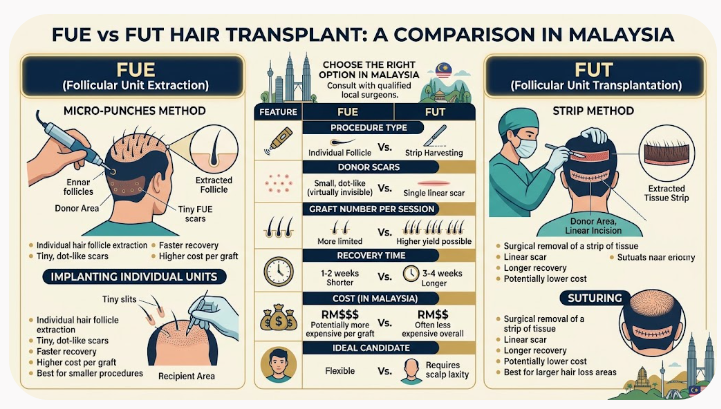
Once you are considered suitable for transplantation, the next question is which technique may be appropriate.
Two established approaches are FUE and FUT.
FUE Hair Transplant
Follicular Unit Extraction involves harvesting individual follicular units from the donor area.
The grafts are then prepared and placed into the recipient area.
FUE can be attractive for men who prefer shorter hairstyles because it does not create the same linear donor scar associated with FUT.
However, FUE still requires careful surgical planning.
Overharvesting can damage the appearance of the donor area.
Therefore, the goal is not simply to extract as many grafts as possible.
FUT Hair Transplant
Follicular Unit Transplantation involves removing a strip of scalp from the donor area.
The follicles are then dissected into individual grafts for transplantation.
FUT can be appropriate for selected patients, particularly when a larger number of grafts may be required.
However, it creates a linear scar.
Therefore, hairstyle preference becomes an important consideration.
Neither technique is automatically better for every patient.
The appropriate technique depends on your scalp, donor area, hair characteristics, goals, and long-term plan.
Why a Personalised Assessment Matters
You may have the same Norwood stage as your friend.
You may even have a similar-looking hairline.
Yet your treatment plan could be completely different.
Your donor density may differ.
Your hair thickness may differ.
Your rate of hair loss may differ.
Your facial proportions may differ.
Your future risk of progression may also differ.
Consequently, copying another person’s graft count or hairline design is not necessarily appropriate.
At Dr. Ruz Hair Transplant, we take a patient-specific approach.
We assess the pattern of your male pattern baldness, examine the donor area, consider your existing hair, and discuss what you hope to achieve.
From there, we can determine whether a transplant makes sense.
Sometimes, the best recommendation is surgery.
Sometimes, it is medical treatment first.
In other situations, monitoring may be the most sensible choice.
Good medicine is not about selling the procedure. It is about recommending the right treatment for the right patient.
What Should You Ask During Your Hair Transplant Consultation?
If you are considering treatment for male pattern baldness, come prepared with questions.
For example, ask:
“What is causing my hair loss?”
Understanding the diagnosis is the first step.
Next, ask:
“Is my hair loss stable enough for transplantation?”
This helps you understand whether surgery should happen now or later.
You can also ask:
“How strong is my donor area?”
Your donor supply determines how much restoration may realistically be possible.
Then ask:
“What happens to my existing hair?”
This is particularly important because male pattern baldness can continue progressing.
Finally, ask:
“What result can realistically be achieved?”
A good consultation should leave you with a clearer understanding of both the possibilities and limitations.
The Bottom Line: Are You Suitable for a Hair Transplant?
If you have male pattern baldness, you may be a suitable candidate for a hair transplant.
However, the diagnosis alone is not enough.
Your suitability depends on several factors working together.
You generally need a suitable donor area, a sufficiently stable pattern of hair loss, a healthy scalp, appropriate general health, and realistic expectations.
Your hair characteristics also influence the final result.
Most importantly, your treatment should make sense for your future hair, not just your appearance today.
That is why a proper consultation is so important.
At Dr. Ruz Hair Transplant, we take the time to understand your hair loss before recommending a treatment plan.
Whether you need medical management, a hair transplant, or simply a clearer understanding of what is happening to your hair, the first step is an accurate assessment.
You do not need to guess whether your male pattern baldness has reached the right stage.
You do not need to compare your hair with someone else’s.
And you do not need to rush into surgery.
Understand your hair loss first. Then make an informed decision.
If you are concerned about male pattern baldness and want to know whether you may be suitable for a hair transplant, arrange a consultation with Dr. Ruz Hair Transplant and contact us HERE or HERE
Your journey to better hair starts with understanding where you are today — and planning carefully for where you want to be tomorrow.
Because your confidence determines your future.