
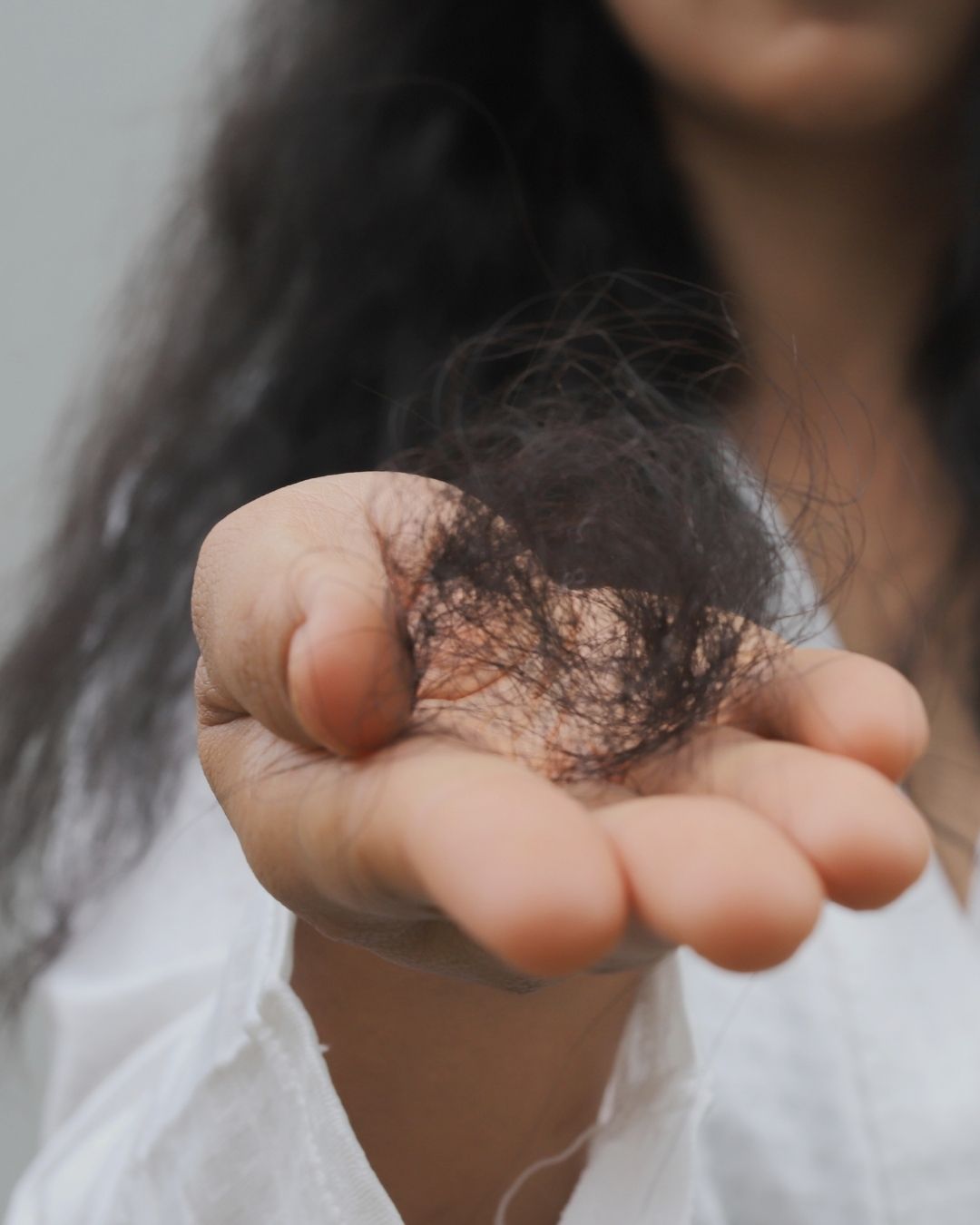
Who Is Suitable for a Hair Transplant? Understanding Hair Fall and Your Candidacy
Hair fall is common, but that does not mean every person experiencing hair loss needs a hair transplant.
In fact, the most important question is not simply “How much hair am I losing?” It is “Why am I losing my hair, and is a hair transplant the right solution for me?”
A hair transplant can restore areas where hair has been permanently lost. However, it cannot automatically stop ongoing hair fall or create unlimited new hair.
Therefore, understanding your type of hair loss is the first step.
At Dr. Ruz Hair Transplant, we look beyond the visible thinning. We assess your hair fall pattern, donor hair, scalp condition, existing hair, medical background, and long-term expectations before recommending treatment.
So, who is suitable for a hair transplant?
Let’s look at the key factors.
What Causes Hair Fall?
Hair fall can happen for many different reasons.
Some people notice gradual thinning over several years. Others suddenly see more hair on their pillow, in the shower, or on their comb.
Importantly, these situations are not necessarily the same.
Hair fall may be associated with:
- Genetic or hereditary hair loss
- Male or female pattern hair loss
- Hormonal changes
- Stress
- Significant weight loss
- Nutritional deficiencies
- Certain medications
- Thyroid or other medical conditions
- Scalp inflammation or disease
- Age-related thinning
- Physical or emotional trauma
Because the causes differ, treatment should differ too.
For example, someone experiencing temporary hair shedding may recover without surgery. On the other hand, someone with permanent thinning and a strong donor area may benefit from hair transplantation.
That is why diagnosis comes before surgery.
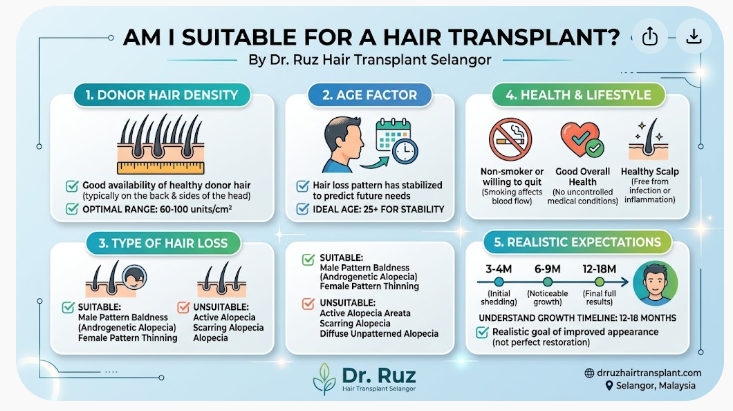
Are You Suitable for a Hair Transplant?
Experiencing hair fall does not automatically make you a hair transplant candidate.
Instead, several factors need to come together.
Generally, you may be a suitable candidate if you have:
- A clear cause or diagnosis of hair loss
- Permanent or sufficiently stable hair loss
- Adequate healthy donor hair
- A healthy scalp
- Realistic expectations
- Good general health
- A suitable area that can benefit from transplantation
- A long-term plan for managing your existing hair
Let’s explore each factor.
1. Your Hair Fall Should Have a Clear Diagnosis
First, we need to understand why your hair is falling.
This is one of the most important parts of a proper hair transplant assessment.
If the underlying cause remains unknown, rushing into surgery may not give you the result you expect.
For instance, sudden diffuse hair fall may have a temporary trigger. Your hair may improve after the underlying problem is addressed.
Therefore, a doctor should first determine whether your hair fall represents permanent hair loss or potentially reversible shedding.
At Dr. Ruz Hair Transplant, the consultation focuses on understanding your individual hair loss rather than simply looking at how much hair you have lost.
2. Your Hair Fall Should Be Stable Enough
A hair transplant moves existing hair follicles from one area of your scalp to another.
It does not stop your natural hair from becoming thinner.
That distinction is extremely important.
Imagine someone has transplanted hair along the front hairline while the untreated hair behind it continues to fall rapidly.
Over time, this could create an unnatural appearance.
For this reason, the timing of transplantation matters.
If your hair fall is still progressing quickly, medical management may be recommended before or alongside a transplant.
This can help protect the hair you still have.
3. You Need Enough Healthy Donor Hair
Your donor area is usually located around the back and sides of the scalp.
These follicles are valuable because they can potentially be moved to areas affected by permanent hair loss.
However, your donor supply is not unlimited.
That means a good transplant is not simply about moving as many grafts as possible.
Instead, the goal is to use the available donor hair intelligently.
A suitable candidate generally has enough healthy donor hair to create meaningful improvement while preserving the appearance of the donor area.
Furthermore, the doctor needs to consider your future hair loss.
A younger patient with significant hair fall may still lose more hair later. Therefore, using too much donor hair early may create problems in the future.
Good hair restoration requires long-term planning.
4. The Pattern of Your Hair Fall Matters
Not all hair loss affects the scalp in the same way.
Some people develop a receding hairline.
Others experience thinning around the crown.
Some develop diffuse thinning across a larger area.
There are also people who lose hair in patches because of specific medical conditions.
Consequently, the pattern of your hair fall can influence whether transplantation is appropriate.
A transplant works best when there is a clearly identifiable area that requires additional density and a suitable donor supply.
In contrast, widespread active hair loss may require further investigation before surgery.
5. Your Hairline Goals Should Be Realistic
One of the biggest mistakes people make is thinking a hair transplant can recreate the hairline they had at 18.
Usually, that is not the best approach.
Your doctor needs to consider:
- Your age
- Facial proportions
- Current hair loss
- Donor hair availability
- Hair density
- Future hair fall
- Natural hairline characteristics
A mature hairline can often look more natural than an extremely low hairline.
Therefore, the goal should not simply be “as much hair as possible.”
The goal should be natural-looking hair that suits your face and remains sustainable over time.
6. Your Scalp Should Be Healthy
Healthy hair begins with a healthy scalp.
Scalp conditions such as inflammation, infection, excessive scaling, or certain forms of scarring hair loss may affect whether transplantation is appropriate.
In some situations, the scalp condition should be treated first.
Once the underlying issue is controlled, your suitability for transplantation can be reassessed.
This is another reason why a proper medical consultation matters.
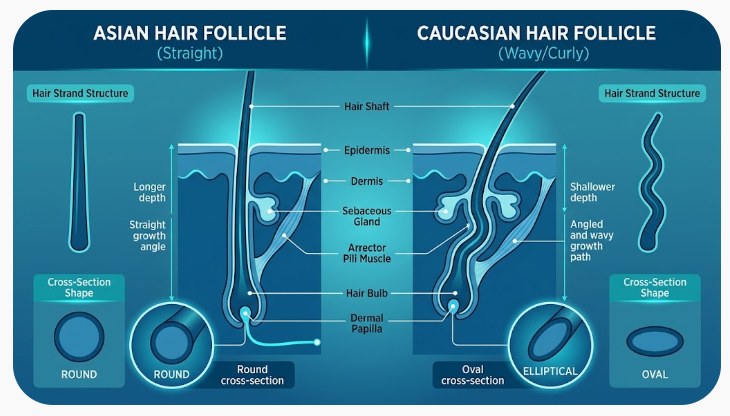
7. Your Hair Characteristics Can Influence the Result
Interestingly, two people with the same number of grafts may achieve very different visual results.
Why?
Because hair characteristics matter.
Factors include:
- Hair thickness
- Hair texture
- Hair colour
- Hair curl or wave
- Contrast between hair and scalp
- Existing hair density
For example, thicker or naturally wavy hair may provide better visual coverage with fewer grafts.
On the other hand, very fine hair may require more careful planning to achieve the desired appearance.
Therefore, graft numbers should not be the only measure of a good transplant.
The quality and strategic placement of the grafts matter too.
8. Your Age Is Only One Part of the Assessment
There is no single age that automatically makes someone suitable or unsuitable for a hair transplant.
However, age can influence treatment planning.
Younger patients may still be experiencing active hair fall. If transplantation is performed too early without considering future loss, the result may become difficult to manage later.
Meanwhile, older patients may have more stable hair loss, making long-term planning easier.
Still, age alone does not determine suitability.
Your diagnosis, donor hair, hair loss pattern and future progression matter more.
9. Your General Health Matters
A hair transplant is a medical procedure.
Therefore, your overall health should be considered before treatment.
Certain medical conditions, medications, bleeding tendencies, uncontrolled illnesses, or scalp problems may influence treatment planning and recovery.
This does not necessarily mean you cannot have a transplant.
Rather, it means your doctor should understand your medical background before proceeding.
A safe treatment plan always comes before cosmetic expectations.
10. You Need Realistic Expectations About Hair Growth
Hair transplantation is not an instant transformation.
The transplanted follicles need time to settle and grow.
Initially, the transplanted hair may shed. This can be part of the normal process.
Afterward, new growth gradually develops.
Therefore, patience is essential.
Your final appearance can take months to develop, and the timeline differs between individuals.
If you expect a full head of thick hair within a few weeks, a hair transplant may disappoint you.
However, if you understand the biological process and have realistic expectations, the experience can be much more rewarding.
11. You Should Be Willing to Protect Your Existing Hair
This is often overlooked.
A hair transplant moves selected follicles into areas affected by permanent hair loss. It does not make every existing follicle permanently resistant to future hair fall.
Your native hair can continue to thin.
As a result, protecting your existing hair can be just as important as restoring lost hair.
Depending on your diagnosis, your doctor may recommend appropriate medical treatment or other strategies to help preserve your remaining hair.
This creates a more complete approach:
Restore what has been lost. Protect what you still have. Plan for what may happen next.
Who May Not Be Suitable for a Hair Transplant?
Not everyone experiencing hair fall should undergo transplantation immediately.
You may need further assessment or alternative treatment if:
- Your hair loss is sudden and unexplained
- Your hair fall is still rapidly progressing
- You have insufficient donor hair
- Your scalp has an untreated medical condition
- You have significant diffuse thinning without a suitable donor supply
- Your hair loss is caused by a condition that may improve with treatment
- You expect unrealistic density
- You want an extremely low or unnatural hairline
- Your general health requires further optimisation
In these situations, surgery may not be the first step.
Sometimes, the best treatment is not having a transplant yet.
That can actually be a sign of good medical planning.
FUE or FUT: Which Is Better for Hair Fall?
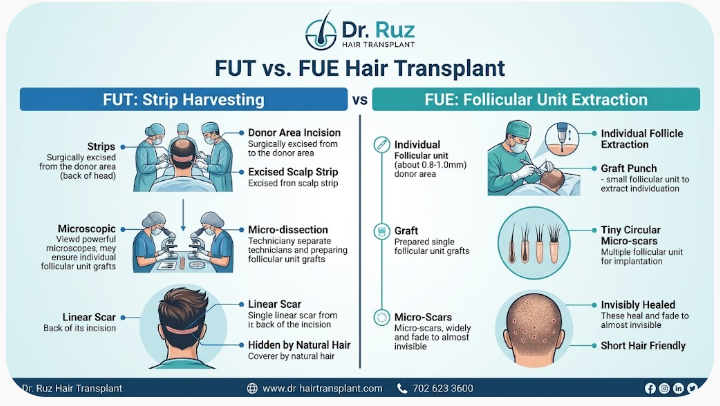
Once you are considered suitable for transplantation, the next question is which technique may be appropriate.
Two commonly discussed approaches are FUE and FUT.
FUE Hair Transplant
Follicular Unit Extraction, or FUE, involves extracting individual follicular units from the donor area before placing them into the recipient area.
FUE is widely chosen because it does not require removing a long strip of scalp.
FUT Hair Transplant
Follicular Unit Transplantation, or FUT, involves removing a strip of donor scalp and dissecting it into individual follicular units.
FUT can be useful in selected patients, particularly when a substantial number of grafts are required and the donor characteristics make the technique appropriate.
However, there is no universally superior technique.
The right choice depends on your scalp, donor supply, hair characteristics, previous procedures and long-term goals.
Why a Personalised Hair Fall Assessment Matters
Searching online for “hair fall treatment” can give you hundreds of answers.
However, your hair loss is unique.
Two people may have similar-looking thinning but completely different underlying causes.
One person may need medical treatment.
Another may benefit from a hair transplant.
Someone else may need to wait until their hair loss becomes more stable.
That is why a personalised assessment is so important.
At Dr. Ruz Hair Transplant, the objective is not simply to determine how many grafts you can receive.
The bigger question is:
“What is the most appropriate long-term plan for your hair?”
Questions to Ask Before Having a Hair Transplant
Before deciding on surgery, consider asking:
1. What is causing my hair fall?
Understanding the diagnosis should come before deciding on treatment.
2. Is my hair loss permanent?
Not every type of hair fall requires transplantation.
3. Is my hair loss stable?
If your hair is still rapidly thinning, the timing of surgery may need reconsideration.
4. Do I have enough donor hair?
Your donor supply determines how much restoration may realistically be possible.
5. What will happen to my existing hair?
A good plan should consider both transplanted and natural hair.
6. What result can I realistically expect?
Understanding achievable density and hairline design can prevent disappointment.
7. What happens after the procedure?
Aftercare is an important part of hair restoration.
At Dr. Ruz Hair Transplant, comprehensive follow-up extends for 18 months, allowing your progress to be monitored in Malaysia rather than leaving you without long-term local follow-up after the procedure.
The Bottom Line: Are You Suitable for a Hair Transplant?
If you are experiencing hair fall, don’t immediately assume that a hair transplant is your only solution.
First, identify the cause.
Next, determine whether the hair loss is permanent and sufficiently stable.
Then, assess your donor hair, scalp health, hair characteristics, age, general health and expectations.
Finally, develop a long-term strategy that considers both the hair you have lost and the hair you still have.
A successful hair transplant is not simply about adding more hair.
It is about making the right decision for your hair today while protecting your appearance for tomorrow.
If hair fall is affecting your confidence, the first step is not necessarily surgery.
The first step is understanding your hair.
At Dr. Ruz Hair Transplant, a personalised assessment can help determine whether you are genuinely suitable for a hair transplant and what approach may be appropriate for your individual situation.