
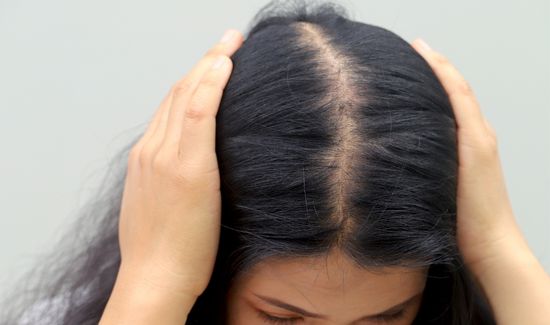
Who Is Suitable for a Hair Transplant? Understanding Hair Loss and Your Candidacy
Hair loss can be frustrating, especially when your hairline starts changing or your scalp becomes more visible.
However, experiencing it does not automatically mean you need a hair transplant.
The more important question is:
Are you actually suitable for a hair transplant?
A hair transplant can restore hair in areas where follicles have been permanently lost. However, it does not work the same way for every type of hair loss.
Therefore, the first step is understanding why you are losing your hair.
At Dr. Ruz Hair Transplant, we look beyond the visible thinning. We assess your pattern of hair loss, donor hair, scalp health, existing hair, medical background and long-term expectations before recommending treatment.
So, who is suitable for a hair transplant?
Let’s explore the factors that matter most.
What Is Hair Loss?
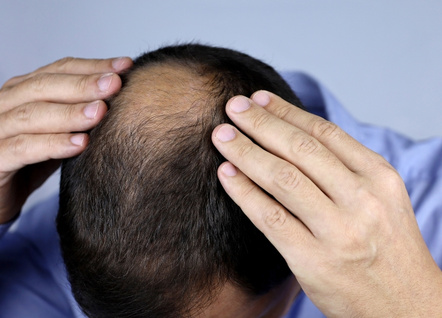
It refers to excessive or progressive baldness from the scalp or other areas of the body.
Some people gradually notice a receding hairline. Others develop thinning around the crown or throughout the scalp.
Meanwhile, some people experience sudden or patchy hair loss.
These patterns can have very different causes.
Hair loss may be associated with:
- Genetic or hereditary factors
- Male pattern Baldness
- Female pattern Baldness
- Hormonal changes
- Ageing
- Stress
- Significant weight loss
- Nutritional deficiencies
- Certain medications
- Thyroid and other medical conditions
- Scalp disorders
- Autoimmune conditions
- Scarring conditions
- Physical or emotional trauma
Because the causes are different, the appropriate treatment can also be different.
For example, some types of hair loss may improve once the underlying cause is treated.
On the other hand, permanent hair loss may leave areas where the original follicles can no longer produce sufficient hair.
That is where hair transplantation may become an option.
Diagnosis should therefore come before surgery.
Are You a Suitable Candidate for a Hair Transplant?
Having hair loss is only one part of the equation.
A suitable candidate generally needs several factors to work together.
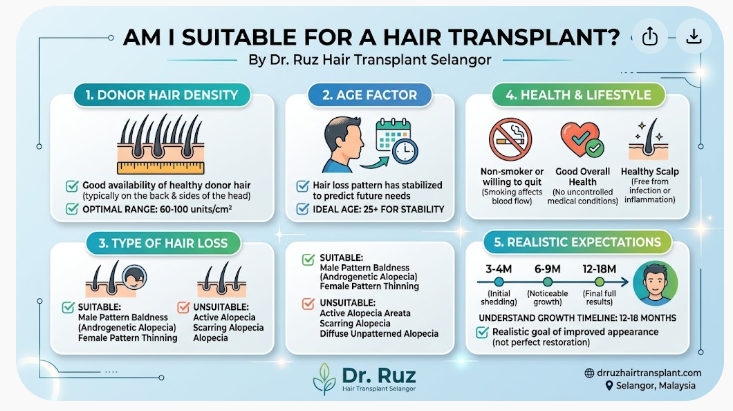
You may be considered suitable for a hair transplant if you have:
- A clear diagnosis
- Permanent or sufficiently stable hair loss
- Adequate healthy donor hair
- A healthy scalp
- Realistic expectations
- Good general health
- A suitable area for restoration
- A long-term plan for protecting your existing hair
Let’s examine each factor in more detail.
1. Your Hair Loss Should Have a Clear Diagnosis
Before considering a hair transplant, the cause of it should be understood.
This is one of the most important parts of the assessment.
Why?
Because not all loss is permanent.
Some conditions can cause temporary or reversible hair loss. In those situations, treating the underlying problem may be more appropriate than immediately undergoing surgery.
For example, sudden diffuse thinning can sometimes be associated with illness, nutritional problems, hormonal changes, stress or other triggers.
Therefore, simply counting how many hairs you lose each day does not tell the whole story.
Instead, the doctor needs to look at the pattern, progression and characteristics of your hair loss.
At Dr. Ruz Hair Transplant, the objective is to understand your individual situation before recommending a treatment plan.
2. Your Hair Loss Should Be Stable Enough
A hair transplant does not stop future hair loss.
This is an important distinction.
During a transplant, healthy follicles are moved from a donor area to areas affected by permanent hair loss.
However, the natural hair surrounding those transplanted follicles can still become thinner.
Imagine restoring the front hairline today while the untreated hair immediately behind it continues to disappear.
Over time, this could create an unnatural appearance.
For that reason, its stability is an important consideration.
If your hair loss is progressing rapidly, your doctor may recommend medical management or observation before transplantation.
In some cases, treatment can be used to help preserve existing hair before surgery.
Therefore, waiting can sometimes produce a better long-term strategy than rushing into a transplant.
3. You Need Enough Healthy Donor Hair
Your donor hair is one of your most valuable resources.
The donor area is generally located around the back and sides of the scalp.
These follicles may be suitable for transplantation into areas affected by permanent hair loss.
However, donor hair is limited.
You cannot simply create an unlimited number of new follicles.
Consequently, a good transplant is not about extracting as many grafts as possible.
Instead, the available donor hair needs to be used strategically.
Your doctor may consider:
- Donor density
- Hair shaft thickness
- Donor area size
- Hair characteristics
- Existing donor scars
- Previous hair transplant procedures
- Expected future loss
Most importantly, the donor area should remain natural-looking after extraction.
A responsible hair restoration plan considers both today’s appearance and tomorrow’s hair loss.
4. The Pattern of Your Hair Loss Matters
Different types of hair loss produce different patterns.
Some people experience:
- Receding temples
- A thinning frontal hairline
- Crown thinning
- Diffuse thinning
- Widespread scalp hair loss
- Patchy hair loss
- Loss associated with scarring
The pattern can influence whether a transplant is appropriate.
Hair transplantation tends to be most useful when there is a clearly identifiable area that requires restoration and a suitable supply of donor follicles.
However, extensive diffuse hair loss can be more complicated.
Similarly, certain medical or scarring conditions may require specialist assessment before transplantation is considered.
Therefore, the pattern of hair loss is just as important as the amount of hair you have lost.
5. Your Hairline Goals Need to Be Realistic
Many people want their old hairline back.
That is understandable.
However, recreating the hairline you had during your teenage years may not always be the most appropriate goal.
Your ideal hairline should take several factors into consideration.
These include:
- Age
- Facial proportions
- Current hair loss
- Donor hair availability
- Hair density
- Hair characteristics
- Potential future hair loss
A natural-looking hairline usually has subtle irregularities rather than looking perfectly straight.
Furthermore, a mature hairline may be more appropriate than an extremely low hairline.
The objective is not simply to place the hair as low as possible.
The objective is to create a hairline that looks natural and remains sustainable.
6. Your Scalp Should Be Healthy
Healthy hair restoration starts with a healthy scalp.
Certain scalp conditions can affect hair growth and may influence the safety or outcome of transplantation.
For example, scalp inflammation, infection, severe scaling or certain forms of scarring hair loss may require treatment first.
Therefore, your doctor should assess the condition of your scalp before surgery.
If an underlying problem is identified, addressing it may be the first priority.
Once the scalp is healthier and the condition is appropriately managed, your suitability can be reassessed.
This is another reason why a medical assessment is more valuable than simply choosing a procedure based on photographs or online advertisements.
7. Your Hair Characteristics Can Affect the Result
Two people can receive a similar number of grafts and still achieve different visual results.
One reason is hair characteristics.
Your result can be influenced by:
- Hair thickness
- Hair texture
- Hair colour
- Hair curl or wave
- Scalp-to-hair colour contrast
- Existing hair density
- Graft quality
For example, thicker or naturally wavy hair may create the appearance of greater coverage.
Meanwhile, fine straight hair may require more careful planning to achieve a similar visual effect.
Therefore, graft numbers alone do not determine the quality of a hair transplant.
Strategic placement and appropriate use of the donor supply matter just as much.
8. Your Age Matters, But It Is Not the Only Factor
There is no single age that automatically makes someone suitable or unsuitable for a hair transplant.
Nevertheless, age can influence the treatment strategy.
Younger people may still be experiencing active loss of hair.
If too many grafts are used too early, the remaining donor supply may become limited when further hair loss occurs later.
Older patients may have more established patterns of hair loss.
However, that does not mean age alone determines candidacy.
Your diagnosis, donor supply, hair loss progression and long-term goals are more important.
A good transplant plan should account for your future, not just your current appearance.
9. Your General Health Should Be Considered
A hair transplant is a medical procedure.
Therefore, your general health should be reviewed before treatment.
Certain medical conditions, medications, bleeding problems or uncontrolled health issues may affect treatment planning and recovery.
That does not necessarily mean you cannot have a transplant.
Instead, it means your doctor should understand your medical history and determine whether additional precautions or treatment are required.
The priority should always be:
Safety first. Cosmetic improvement second.
10. You Need Realistic Expectations About Hair Growth
A hair transplant is not an instant solution.
The transplanted follicles need time to establish themselves and begin producing new growth.
In the early stages, some transplanted hairs may shed.
This can be part of the normal process.
New growth then develops gradually.
Consequently, patience is an essential part of the process.
Your final result takes time, and individual growth rates can vary.
Someone expecting a completely transformed head of hair within several weeks may become unnecessarily disappointed.
Instead, understanding the normal timeline can help you approach the procedure with realistic expectations.
Hair restoration is a biological process, not an overnight transformation.
11. You Should Consider Your Existing Hair
One of the most important principles of hair restoration is often overlooked.
A transplant restores areas that have lost hair.
It does not automatically prevent your existing natural hair from becoming thinner.
Therefore, preserving your existing hair can be just as important as replacing the hair you have already lost.
Depending on your diagnosis, your doctor may recommend appropriate medical management or other strategies to help maintain your existing follicles.
This creates a more complete approach:
Restore what has been lost. Protect what remains. Plan for what comes next.
Who May Not Be Suitable for a Hair Transplant?
Not everyone experiencing hair loss should have surgery immediately.
You may require further assessment or alternative treatment if:
- Your hair loss is sudden and unexplained
- Your hair loss is rapidly progressing
- You have insufficient donor hair
- Your scalp has an untreated condition
- You have extensive diffuse hair loss
- Your hair loss may be reversible
- You have certain forms of scarring hair loss
- You expect unrealistic density
- You want an excessively low hairline
- Your general health requires further assessment
In these situations, a transplant may not be the first step.
Sometimes, the best medical decision is to delay surgery.
That is not necessarily bad news.
In fact, it can prevent you from undergoing a procedure before the timing is right.
FUE or FUT: Which Is Suitable for Hair Loss?
Once you are considered a suitable candidate, another question arises:
Which hair transplant technique is appropriate for you?
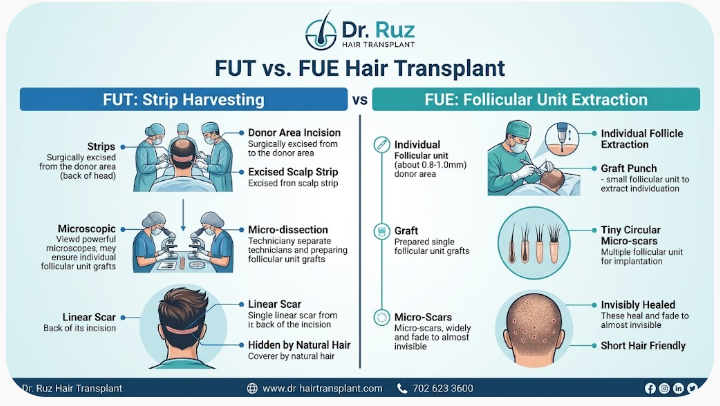
Two established techniques are FUE and FUT.
FUE Hair Transplant
Follicular Unit Extraction, commonly known as FUE, involves extracting individual follicular units from the donor area.
These follicles are then prepared and transplanted into the recipient area.
FUE is commonly selected when individual follicle extraction is appropriate for the patient’s donor characteristics and restoration goals.
FUT Hair Transplant
Follicular Unit Transplantation, or FUT, involves removing a strip of donor scalp.
The strip is then carefully dissected into individual follicular units for transplantation.
FUT can be appropriate for selected patients, particularly when a substantial number of grafts are required and the patient’s donor characteristics make the technique suitable.
However, neither technique is automatically the best choice for everyone.
The appropriate approach depends on your:
- Hair loss pattern
- Donor supply
- Hair characteristics
- Scalp condition
- Previous procedures
- Restoration goals
- Long-term pattern
The right technique is the one that fits the patient—not simply the one that is most popular.
Why a Personalised Hair Loss Assessment Matters
You can find thousands of articles about this topic online.
You can also find countless before-and-after photographs.
However, none of them can accurately determine whether you are suitable for a hair transplant.
Two people can have similar-looking hair loss while having completely different causes.
One person may benefit from medical treatment.
Another may be an excellent transplant candidate.
Someone else may need to wait until their hair loss becomes more stable.
Therefore, an individual assessment is essential.
At Dr. Ruz Hair Transplant, the goal is not simply to determine:
“How many grafts can we transplant?”
The more important question is:
“What is the best long-term plan for your hair?”
That difference matters.
Questions to Ask Before Having a Hair Transplant
Before deciding on a procedure, consider asking your doctor:
What is causing my hair loss?
A proper diagnosis should come before treatment.
Is my hair loss permanent?
Not every type of hair loss requires surgery.
Is my hair loss stable?
Rapidly progressing hair loss may require a different approach.
Do I have enough donor hair?
Your donor supply determines what level of restoration may realistically be achieved.
What will happen to my existing hair?
A long-term plan should protect the hair you still have.
What kind of hairline can I realistically achieve?
A natural hairline should complement your face and account for future baldness.
How long will my recovery and growth take?
Understanding the process can help you prepare properly.
What follow-up care will I receive?
Aftercare is an important part of responsible hair restoration.
At Dr. Ruz Hair Transplant, comprehensive follow-up is provided for 18 months, allowing your hair growth and recovery to be monitored locally in Malaysia.
The Bottom Line: Are You Suitable for a Hair Transplant?
If you are experiencing it, don’t assume that a hair transplant is automatically the answer.
First, understand the cause.
Next, determine whether it is permanent and sufficiently stable.
Then, assess your donor hair, scalp health, hair characteristics, age, general health and expectations.
Finally, develop a long-term strategy that considers both the hair you have lost and the hair you still have.
A successful hair transplant is not simply about putting more hair onto your scalp.
It is about using your available donor hair wisely to create a natural-looking result that fits your face and your long-term hair loss pattern.
If hair loss is affecting your confidence, the first step does not necessarily have to be surgery.
The first step is understanding your hair loss.
At Dr. Ruz Hair Transplant, a personalised assessment can help determine whether you are genuinely suitable for a hair transplant and which treatment approach may be appropriate for your individual needs.
Because your confidence determines your future.