
Hair Restoration Services in Malaysia | Dr Ruz Hair Transplant
Hair loss can change more than your appearance.
It can affect your confidence. It can change how you style your hair. More importantly, it can influence how you see yourself.
At Dr Ruz Hair Transplant, we take a different approach.
Instead of treating hair loss as a purely cosmetic concern, we first look for the factors behind it. Then, we develop a treatment strategy around your scalp, your hair, your donor supply, and your long-term goals.
Therefore, every hair restoration journey begins with understanding.
We assess your hair loss pattern. We examine your scalp. We evaluate your existing hair and donor area. Where appropriate, we also consider medical and nutritional factors.
Then, we determine which treatment options may suit you.
Depending on your condition, your treatment plan may include medical hair restoration, regenerative treatments, FUE hair transplantation, DHI/GII implantation, or a combination of approaches.
Most importantly, we focus on long-term hair restoration rather than simply adding hair to an area of thinning.
A Complete Hair Restoration Approach
Successful hair restoration requires more than a procedure.
First, we need to understand why you are losing hair. Next, we determine how much hair you may realistically restore. After that, we protect the hair that you still have.
Finally, we monitor your progress over time.
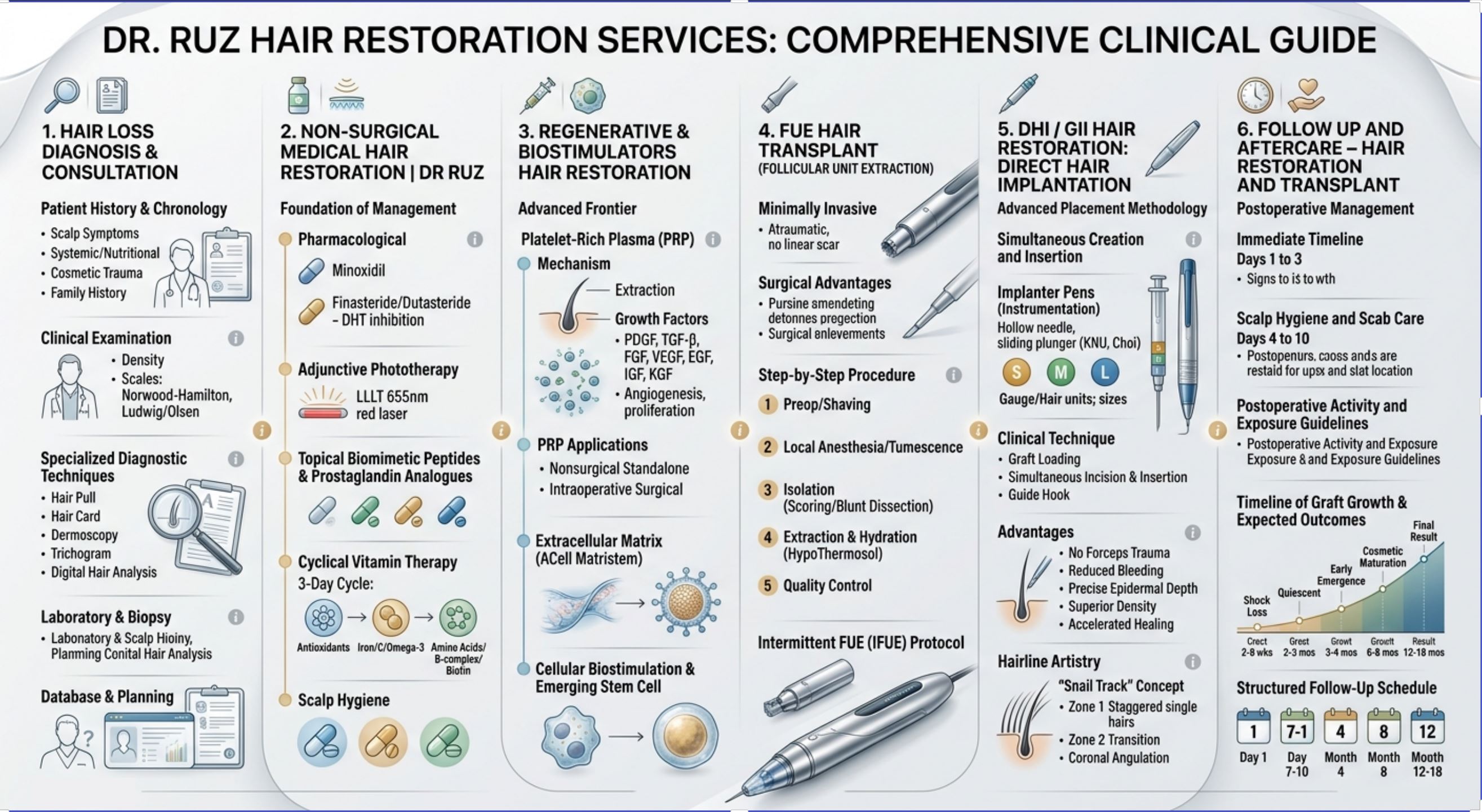
At Dr Ruz Hair Transplant, our hair restoration approach therefore covers:
- Hair loss diagnosis and consultation
- Scalp and hair assessment
- Non-surgical medical hair restoration
- Regenerative and biostimulator treatments
- FUE hair transplant
- DHI / GII hair implantation
- Natural hairline design
- Post-treatment care
- Long-term follow-up and outcome monitoring
This integrated approach helps create a treatment plan that is personalised rather than one-size-fits-all.
1. Hair Loss Diagnosis & Consultation
Start With the Cause, Not Just the Symptom
Before considering a hair transplant, we first need to understand your hair loss.
Hair loss can have different causes. For example, gradual pattern thinning may follow a different process from sudden diffuse shedding.
Likewise, scalp inflammation, nutritional factors, medication, hormonal factors, genetics, and cosmetic trauma can influence hair health.
Therefore, a proper consultation provides the foundation for your treatment plan.
During your consultation, we take a detailed history of your hair loss and overall circumstances.
We look at:
- When your hair loss started
- How quickly it has progressed
- Whether the loss is gradual or sudden
- Your family history of hair loss
- Previous hair treatments
- Medication history
- Styling and chemical treatments
- Scalp symptoms
- Nutritional and lifestyle factors
- Previous hair transplant procedures
We also discuss what concerns you most.
After all, restoring hair is not simply about numbers.
Your desired hairline, hairstyle, density expectations, and long-term goals all matter.
Detailed Scalp Assessment
Next, we examine the scalp and existing hair.
We assess hair density, hair calibre, curl, colour contrast, and the appearance of follicular openings.
These observations help distinguish different types of hair loss.
We can also classify common pattern hair loss using established clinical systems.
For male pattern hair loss, the Norwood-Hamilton classification helps describe the progression from frontotemporal recession to more extensive vertex and midscalp loss.
For female pattern hair loss, systems such as the Ludwig classification and the Olsen “Christmas tree” pattern can help describe the distribution of thinning.
Therefore, diagnosis gives us a clearer picture of where you are now.
It also helps us plan where you may want to go.
Advanced Hair and Scalp Assessment
Where clinically appropriate, additional diagnostic techniques may support the assessment.
These can include:
Hair Pull Test
This simple bedside test helps assess active hair shedding.
Hair Card and Felt Examination
A contrasting card can help reveal fine, miniaturised, short, or broken hairs that may otherwise be difficult to see.
Dermoscopy and Trichoscopy
Magnified scalp examination can reveal changes in hair diameter, follicular structures, and other patterns associated with different forms of alopecia.
Trichogram and Clip Testing
Selected cases may require closer examination of hair roots and growth phases.
Digital Hair Analysis
Digital systems can provide quantitative information about hair density, hair counts, and terminal-to-vellus hair ratios.
Therefore, the consultation does more than identify visible bald spots.
It creates a clearer clinical picture of your hair and scalp.
Laboratory Evaluation When Needed
Hair loss can sometimes involve systemic factors.
Therefore, when your clinical history suggests a possible underlying issue, targeted blood investigations may be considered.
Depending on the case, testing may include parameters such as:
- Full blood count
- Thyroid-stimulating hormone
- Ferritin
- Vitamin D
- C-reactive protein
- Prolactin
- Testosterone
- DHEA-S
- Iron studies
These investigations are not automatically required for every patient.
Instead, they are considered when clinically appropriate.
In uncertain cases, a scalp biopsy may also be considered to help investigate inflammatory or scarring conditions.
Your Personal Hair Database
Finally, relevant diagnostic information can be documented as part of your hair restoration record.
This may include:
- Hair and scalp photographs
- Trichoscopic findings
- Donor density
- Hair loss classification
- Donor-to-recipient considerations
- Treatment objectives
This baseline allows your progress to be compared over time.
More importantly, it helps us develop a treatment strategy around your hair, rather than somebody else’s.
2. Non-Surgical Medical Hair Restoration
Protect the Hair You Still Have
A hair transplant moves existing follicles.
However, it does not automatically stop genetic hair loss affecting your native, non-transplanted hair.
Therefore, medical hair restoration can play an important role before, during, and after transplantation.
The objective is to help stabilise ongoing hair loss, support existing follicles, and optimise the overall appearance of your hair.
Depending on your clinical situation, treatment may involve pharmacological therapy, phototherapy, nutritional support, or other adjunctive approaches.
Minoxidil
Minoxidil is an established medical treatment used in hair-loss management.
It can help support follicular activity and promote the transition of follicles into the active growth phase.
It may also help increase hair shaft diameter.
Topical formulations are available in different strengths, including 2% and 5%.
For selected patients, low-dose oral minoxidil may also be considered by a doctor.
However, suitability depends on the individual.
Therefore, medical treatment should be selected according to your clinical circumstances rather than simply following a generic hair-loss programme.
Finasteride and Dutasteride
Androgenetic alopecia is strongly associated with the effect of dihydrotestosterone, or DHT, on susceptible hair follicles.
Finasteride works by inhibiting Type 2 5-alpha-reductase.
Dutasteride inhibits both Type 1 and Type 2 5-alpha-reductase.
Consequently, these medicines can reduce DHT activity and may help slow follicular miniaturisation in appropriate patients.
However, these treatments require medical assessment.
Your doctor should consider suitability, risks, benefits, and individual circumstances before prescribing them.
Low-Level Laser Therapy
Low-Level Laser Therapy, or LLLT, provides a non-invasive approach that may complement medical hair-loss treatment.
Red laser light is used to deliver photobiomodulation to the scalp.
The treatment is designed to support follicular activity and the hair growth cycle.
Therefore, LLLT may be incorporated as an adjunct rather than viewed as a replacement for every other treatment.
Topical Hair Restoration Support
Some treatment programmes may also incorporate topical biomimetic peptides or other emerging topical agents.
These formulations may contain ingredients such as procapil, biochanin A, and growth-signalling peptides.
Because evidence and suitability can vary between products and patients, treatment selection should remain clinically guided.
Nutritional Support
Hair growth also depends on adequate nutrition.
The hair shaft is largely composed of protein. Meanwhile, the rapidly dividing cells within the hair matrix require energy and nutrients.
Therefore, nutritional deficiencies and restrictive eating patterns can become relevant when evaluating hair loss.
Where appropriate, nutritional support can form part of an overall hair restoration plan.
The source protocol describes a cyclical nutritional programme involving different nutrients across a three-day rotation.
It also describes scalp hygiene measures, including the use of medical anti-dandruff shampoo containing ketoconazole.
The exact programme should, however, be tailored according to clinical need.
3. Regenerative & Biostimulator Hair Restoration
Support the Scalp Environment
Hair restoration does not only involve hair follicles.
The surrounding scalp environment also matters.
Therefore, regenerative and biostimulator treatments may be used to support the follicular environment and complement other hair restoration strategies.
One of the key treatments is Platelet-Rich Plasma, or PRP.
PRP Hair Treatment
PRP uses a concentration of platelets prepared from your own blood.
After processing, the platelet-rich component can be used as an autologous treatment.
When activated, platelets release a range of growth factors.
These include:
- Platelet-derived growth factor
- Transforming growth factor-beta
- Fibroblast growth factor
- Vascular endothelial growth factor
- Epidermal growth factor
- Insulin-like growth factors
- Keratinocyte growth factor
These signalling molecules are involved in processes such as cellular activity, tissue repair, vascular support, and follicular biology.
Therefore, PRP may be incorporated into a broader hair restoration strategy.
PRP as a Non-Surgical Treatment
PRP can be administered directly into areas of thinning scalp using fine injections.
Depending on the treatment plan, microneedling or other techniques may also be considered.
The goal is to support the local scalp environment and existing follicles.
Consequently, PRP may be considered for patients who are not ready for surgery or who require additional support as part of a wider programme.
PRP During Hair Transplantation
PRP may also be used in conjunction with hair transplantation.
The source protocol describes its use in the recipient area and as a holding solution for extracted grafts.
The objective is to support the graft environment during the transplantation process.
Therefore, regenerative treatment can potentially form part of both non-surgical and surgical hair restoration strategies.
Extracellular Matrix Treatments
The source protocol also describes ACell MatriStem, an extracellular matrix-based material derived from porcine urinary bladder tissue.
It is described as being used to support tissue regeneration and follicular remodelling.
When combined with PRP, the protocol describes a biostimulatory environment intended to support thickening and wound healing.
Because these treatments are specialised, your doctor should determine whether they are appropriate for your individual case.
Emerging Cellular Approaches
Hair restoration continues to evolve.
Research into cell-conditioned media, growth factors, dermal papilla cells, keratinocytes, and progenitor cells continues to explore new approaches to follicular regeneration.
These emerging technologies represent an evolving area of regenerative medicine.
They should therefore be distinguished from established clinical hair transplantation techniques.
4. FUE Hair Transplant in Malaysia
Follicular Unit Extraction
FUE hair transplant is a minimally invasive hair transplantation technique.
Instead of removing a linear strip of scalp, FUE extracts individual follicular units from the donor area.
Each naturally occurring follicular unit may contain one to four hairs.
The surgeon then prepares these grafts for implantation into areas affected by hair loss.
Therefore, FUE allows the donor area to be harvested through individual extraction points rather than a continuous linear strip.
Why FUE Is Different
Traditional FUT, or strip harvesting, removes a strip of scalp tissue.
FUE takes a different approach.
Small punches isolate individual follicular units.
The donor area can therefore heal through multiple small extraction sites.
For patients who prefer shorter hairstyles, this approach can be particularly relevant because it does not create the same type of linear donor scar associated with strip harvesting.
However, FUE still produces small punctate scars.
The final appearance depends on factors such as punch size, extraction pattern, healing, donor characteristics, and surgical technique.
FUE Surgical Planning
Before extraction begins, the donor area is assessed and prepared.
The hair may be trimmed to short stubble.
This allows the surgeon to see the direction in which individual hairs emerge.
Then, local anaesthesia is administered.
Tumescent anaesthesia can help stabilise the tissue and reduce bleeding during extraction.
Follicular Unit Extraction
The surgeon carefully isolates each selected follicular unit.
The source protocol describes a two-step approach.
First, a sharp punch scores around the follicular unit.
Then, a blunt dissection step can help separate deeper attachments while reducing the risk of damaging the follicle.
After isolation, fine forceps gently extract the graft.
The extracted graft is then placed into an appropriate sterile holding solution.
Graft Quality Control
Every graft matters.
Therefore, grafts can be inspected under magnification.
They can also be categorised according to the number of hairs they contain.
This allows the surgical team to plan their placement according to the aesthetic requirements of different scalp zones.
Single-hair grafts, for example, can be particularly useful for creating a soft-looking frontal transition.
Meanwhile, multi-hair grafts can contribute to density behind the hairline.
Intermittent FUE
The source protocol also describes an Intermittent FUE (IFUE) approach.
Instead of performing a prolonged extraction stage followed by implantation, the procedure can be organised into coordinated cycles of extraction, recipient-site creation, and graft placement.
The objective is to reduce the time grafts remain outside the body.
This approach forms part of the graft-handling strategy described in the clinical protocol.
5. DHI / GII Hair Restoration
Direct Hair Implantation Using an Implanter
DHI, also described in the source as Graft Insertion Using Implanter (GII), represents a different method of graft placement.
In conventional implantation, recipient sites may first be created before grafts are inserted.
With an implanter technique, the loaded graft travels inside a specialised implanter pen.
The instrument creates the recipient opening and places the graft in a coordinated movement.
Therefore, the surgeon can control the direction, angle, and placement of each graft with an implanter.
Precision Through Implanter Pens
An implanter pen is a specialised, spring-loaded instrument with a hollow needle and internal plunger.
Different needle sizes can accommodate different follicular-unit sizes.
The source protocol describes:
- Small needles for single-hair grafts
- Medium needles for two-hair grafts
- Larger needles for three- and four-hair grafts
This allows the implantation method to be adapted according to the graft.
Graft Loading
The graft is carefully loaded into the implanter.
The delicate follicular structures remain protected within the needle.
This can help the surgical team handle grafts with controlled movements throughout the placement process.
Controlled Implantation
The surgeon positions the implanter according to the desired direction and angle of hair growth.
The needle then enters the recipient area.
At the appropriate depth, the plunger releases the graft while the needle is withdrawn.
Therefore, graft placement becomes a controlled and deliberate process.
Creating Natural Density
Hair transplantation is not simply about placing as many grafts as possible.
It is about placing the right graft in the right location.
Single-hair grafts can create a softer transition.
Two-hair grafts can build density behind the leading edge.
Three- and four-hair grafts can contribute further density in the frontal forelock and midscalp.
Consequently, thoughtful graft distribution can help create a more natural visual transition.
6. Natural Hairline Design
Your Hairline Is the First Impression
The hairline is one of the most visible areas of a hair transplant.
Therefore, its design deserves careful attention.
A natural hairline rarely appears as a perfectly straight horizontal line.
Instead, it contains subtle irregularities, transitions, and changes in density.
For that reason, recreating nature requires more than drawing a line and filling it with grafts.
The “Snail Track” Hairline Concept
The source protocol describes a “Snail Track” approach to hairline design.
The concept uses different graft types across different zones.
Zone 1: Anterior Micro-Irregular Zone
The first 2 to 3 cm can use carefully selected single-hair follicular units.
These fine hairs can be arranged in a staggered and feathered pattern.
The objective is to avoid an abrupt artificial border.
Instead, the transition can appear softer and more irregular.
Zone 2: Gradual Density Transition
Behind the leading edge, graft density gradually increases.
Two-hair units can follow the single-hair transition.
Then, larger follicular units can contribute to density in the frontal forelock and midscalp.
This creates a visual progression from fine hairs at the front to greater density behind them.
Hair Direction and Angulation
Hair direction also matters.
The surgeon considers the natural growth direction of surrounding hair when determining graft angle and orientation.
Therefore, the final appearance depends not only on where the graft is placed, but also on how it is placed.
This is where surgical planning and aesthetic judgement become especially important.
7. Hair Transplant Aftercare & Follow-Up
Your Treatment Does Not End When Surgery Ends
Hair transplantation is a process.
The procedure is only one part of that process.
After surgery, your newly transplanted grafts need appropriate care.
Therefore, structured aftercare and follow-up remain important parts of the treatment journey.
At Dr Ruz Hair Transplant, postoperative care focuses on protecting the grafts, supporting healing, monitoring progress, and helping you understand what to expect.
Your Early Recovery
Day 1
The first postoperative review takes place according to the treatment plan.
The donor and recipient areas are inspected.
The team can also review scalp hygiene and aftercare instructions.
The source protocol describes cleansing the donor area and using soothing topical products where appropriate.
Recipient Scalp Hydration
The recipient area requires gentle handling.
The source protocol recommends frequent spraying with sterile thermal water or saline during the first several days.
The purpose is to keep the recipient area appropriately hydrated and minimise heavy crust formation.
Managing Swelling
Some patients develop forehead or facial swelling during the first few days.
This can occur as postoperative fluid moves down from the scalp.
The source protocol recommends measures such as an appropriate forehead headband and elevated sleeping positions.
Cold packs may be used on the forehead.
They should not be placed directly over transplanted grafts.
Scalp Washing After Hair Transplant
Your scalp needs to remain clean.
However, it also needs protection during the early healing period.
Therefore, high-pressure water should be avoided initially.
Once washing is permitted according to your postoperative instructions, the scalp can be cleaned gently.
A mild shampoo can be lathered in the hands first.
Then, the scalp can be cleaned using the soft pads of the fingers.
Avoid using fingernails.
Avoid aggressive rubbing.
Instead, use gentle movements.
Scab Care
Small crusts around the transplanted grafts are common during healing.
They usually loosen naturally.
If crusting persists, your clinical team may provide specific instructions to help soften and remove it safely.
Therefore, resist the temptation to scratch or pick at the recipient area.
Gentle care protects the healing scalp.
Returning to Normal Activities
Recovery varies between individuals.
Therefore, follow the specific activity restrictions provided by your surgical team.
The source protocol advises avoiding strenuous activity, heavy exercise, weightlifting, soccer, and strenuous physical work during the early recovery period.
Gentle walking may be introduced earlier according to postoperative instructions.
You should also protect the scalp from excessive environmental exposure.
The source protocol recommends avoiding direct sunlight, swimming pools, saunas, dust, and similar exposure during the early healing period.
Loose-fitting headwear may be appropriate when permitted.
However, it should not rub against the grafts.
Hair colouring, perming, harsh styling products, and hairpieces should also be delayed until the scalp has adequately healed.
Understanding Your Hair Growth Timeline
Do Not Judge Your Result Too Early
One of the most important parts of hair transplant aftercare is knowing what to expect.
Hair does not grow immediately after transplantation.
Instead, transplanted follicles go through several stages.
Therefore, patience is essential.
Weeks 2–8: Shock Loss
Transplanted hair shafts may shed during the early weeks after surgery.
This can be alarming.
However, shedding of the visible shaft does not necessarily mean that the follicle has been lost.
The follicular unit remains beneath the scalp and can enter another growth cycle.
Months 2–3: Resting Phase
The follicles may remain relatively quiet while the scalp continues to recover.
During this period, visible growth may still be limited.
Months 3–4: Early New Growth
Fine new hairs may begin emerging from the scalp.
At first, they can look thin and delicate.
That is normal.
Months 6–8: Visible Cosmetic Improvement
As the follicles continue developing, patients can begin to notice improvements in coverage, density, and hair calibre.
The appearance continues to evolve.
Months 12–18: Maturation
Hair transplant results continue to mature over time.
The source protocol places maximum maturation and final cosmetic assessment within approximately 12 to 18 months.
Therefore, a hair transplant should be judged over months rather than weeks.
Structured Long-Term Follow-Up
We Continue to Monitor Your Progress
Follow-up gives both patient and doctor an opportunity to assess the developing result.
It also provides an opportunity to identify concerns early.
The source protocol outlines a structured follow-up pathway:
Day 1
Postoperative inspection, dressing management, and hygiene guidance.
Day 7–10
Assessment of healing and scab shedding. If applicable, suture or staple removal can also be performed.
Month 4
Assessment of early hair emergence and discussion of concerns such as shock loss.
Month 8
Assessment of developing density and styling options.
Month 12–18
Long-term evaluation with comparative photography and assessment of the overall cosmetic result.
This extended follow-up approach helps you understand how your hair restoration develops over time.
Why a Long-Term Hair Restoration Strategy Matters
Hair transplantation can restore hair to areas that have become visibly thin or bald.
However, your hair continues to age.
Your native hair can also continue to change.
Therefore, the most meaningful approach looks beyond the day of surgery.
We consider:
- Your current pattern of hair loss
- Your donor supply
- Your existing native hair
- Your future hair-loss potential
- Your desired hairline
- Your density goals
- Your medical treatment options
- Your long-term maintenance strategy
As a result, the goal is not simply to perform a procedure.
The goal is to create a sustainable hair restoration plan.
Your Hair. Your Plan. Your Restoration Journey.
You do not have to decide on a hair transplant simply because you are losing hair.
First, understand what is happening.
Then, understand your options.
After that, choose a treatment strategy based on your individual condition and goals.
At Dr Ruz Hair Transplant, we combine detailed assessment, medical hair restoration, regenerative approaches, advanced FUE techniques, implanter-based graft placement, aesthetic hairline planning, and structured aftercare.
Most importantly, we look at the complete journey.
Because natural-looking hair restoration is not just about adding grafts.
It is about diagnosis, planning, precision, protection, and patience.
Ready to Understand Your Hair Loss?
If hair thinning, receding hairline, or baldness is affecting your confidence, the first step is a proper assessment.
Discover what is happening beneath the surface.
Understand your donor area.
Explore your treatment options.
And build a hair restoration plan designed around your needs.
Book a consultation with Dr Ruz Hair Transplant in Malaysia and take the first step towards a more informed hair restoration journey.
Dr. Ruz @ Dr. Ruzaidi
Hair Restoration & Hair Transplant Malaysia
WhatsApp / Call: +6010-3819800
Website: drruzhairtransplant.com