
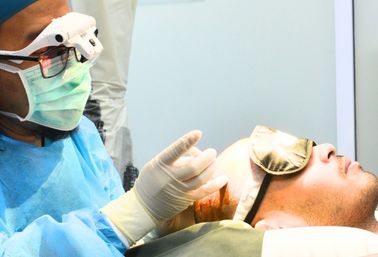
Advanced DHI Hair Restoration With Precision Graft Implantation
DHI (Direct Hair Implantation) is an advanced method of placing individual hair grafts during a hair transplant. Technically, the implantation process is more accurately described as Graft Insertion using an Implanter (GII).
At Dr Ruz Hair Transplant, we provide DHI/GII hair restoration using specialised implanter devices to give the surgeon precise control over graft placement, angle, direction, depth, and density.
Unlike conventional hair transplant placement, where recipient sites are created first and grafts are subsequently inserted with forceps, DHI/GII allows the recipient opening and graft insertion to occur in a coordinated movement.
This approach can be particularly useful when precise control is important, such as when reconstructing the frontal hairline, temples, or other areas where the direction of individual hairs contributes significantly to a natural appearance.
However, DHI is not simply about using a special implantation pen.
A successful hair transplant depends on the entire process, including diagnosis, donor planning, FUE extraction, graft handling, hairline design, implantation technique, and long-term hair-loss management.
Therefore, at Dr Ruz Hair Transplant, DHI/GII is used as part of a personalised hair restoration strategy, rather than as a one-size-fits-all procedure.
What Is DHI Hair Transplant?
DHI stands for Direct Hair Implantation.
The term is commonly used to describe hair transplantation using a specialised hollow implanter needle. The graft is loaded inside the device before being placed directly into the recipient area.
Technically, this process is known as Graft Insertion using an Implanter, or GII.
The implanter contains a hollow, beveled surgical needle and an internal implanting rod operated by a spring-loaded plunger.
The surgeon positions the needle at the desired location, angle, and depth.
The needle then enters the scalp while the plunger pushes the graft into position.
As the needle withdraws, the graft remains inside the recipient site.
Consequently, site creation and graft insertion happen as part of the same coordinated movement.
This is the fundamental principle behind DHI/GII hair implantation.
DHI and GII: What Is the Difference?
Patients often see the terms DHI and GII used interchangeably.
DHI, or Direct Hair Implantation, is the more familiar term used by patients and the hair restoration industry.
GII, or Graft Insertion using an Implanter, is a more technically descriptive term for the actual implantation process.
Therefore, when discussing DHI, it is useful to understand what the procedure actually involves.
The important feature is not simply the name.
Instead, it is the use of an implanter device to control the insertion of individual follicular unit grafts.
At Dr Ruz Hair Transplant, we provide DHI/GII implantation for appropriately selected patients.
How Does DHI/GII Hair Implantation Work?
A DHI hair transplant involves several carefully coordinated stages.
The procedure begins with assessment and planning.
Next, follicular unit grafts are extracted from the donor area, commonly using FUE (Follicular Unit Extraction).
After extraction, the grafts are examined, sorted, and prepared.
The grafts are then loaded into the DHI implanters.
Finally, the surgeon places the grafts into the recipient area according to the planned hairline, angle, direction, density, and depth.
Therefore, DHI is not necessarily a separate extraction technique.
A patient can undergo FUE extraction followed by DHI/GII implantation.
This combination is commonly used when the surgeon wants individual follicular units to be harvested and then implanted with an implanter.
The DHI Implanter
The DHI implanter is a specialised surgical device.
Although it may look similar to a pen, it is designed specifically for follicular graft implantation.
The device generally contains:
- An ergonomic plastic or metal housing
- A hollow surgical steel needle
- A grooved channel
- An internal implanting rod
- A spring-loaded plunger
The graft sits inside the hollow needle.
When the surgeon activates the plunger, the internal rod pushes the graft out of the needle.
At the same time, the needle withdraws from the scalp.
As a result, the graft is placed into the recipient site without requiring the surgeon to first create an empty slit and then insert the graft separately.
DHI Implanter Needle Sizes
One of the important aspects of DHI/GII is matching the implanter needle to the graft.
Follicular units contain different numbers of hairs.
Some grafts contain one hair.
Others contain two or three hairs, while some follicular units may contain more.
Therefore, the implanter needs to be selected according to the graft’s characteristics.
Common needle sizes include:
1-Hair Grafts
One-hair grafts can be implanted using 0.6 mm to 0.8 mm needles, including 22-gauge needles.
These smaller grafts can be particularly useful when creating a soft and natural-looking frontal hairline.
2-Hair Grafts
Two-hair grafts can be delivered using approximately 0.8 mm to 1.0 mm needles, including 20-gauge needles.
These grafts may be useful when building density behind the hairline.
3-Hair Grafts
Three-hair grafts can be delivered using approximately 1.0 mm to 1.2 mm needles, including 18-gauge needles.
Larger grafts can contribute to density in appropriate areas of the scalp.
The exact needle selection depends on the graft and surgical requirements.
Graft Loading: An Important Part of DHI
Before a graft can be implanted, it needs to be loaded into the implanter.
This may sound simple.
However, graft handling is a technically important part of the procedure.
A dedicated surgical technician, often referred to as the loader, places the graft into the hollow needle using fine jeweller’s forceps.
The graft should be handled carefully.
The loader should grasp the upper hair shaft rather than squeezing structures around the hair bulb or the bulge area.
This approach helps minimise unnecessary mechanical trauma.
Furthermore, grafts need to remain appropriately hydrated and protected while they wait for implantation.
Therefore, careful graft preparation is just as important as the final insertion.
Why Longer Hair Can Help During DHI
DHI procedures can sometimes benefit from leaving the donor hair slightly longer.
A donor hair length of approximately 5 to 10 mm can make graft loading easier.
It can also help the surgical team:
- Identify individual grafts
- Count the number of hairs within each follicular unit
- Maintain correct graft orientation
- Load grafts more accurately
Consequently, longer hair can provide practical advantages during the preparation and loading stages.
However, the ideal donor preparation depends on the individual patient and the surgical plan.
DHI Implantation Angle and Direction
One of the major advantages of DHI/GII is the level of control available during implantation.
The surgeon determines the angle and direction of each graft according to the surrounding hair.
A typical implantation angle can range from approximately 45 to 70 degrees.
However, the appropriate angle varies according to the treatment area.
The frontal hairline usually requires a flatter and carefully controlled orientation.
Meanwhile, other areas of the scalp may require different angles depending on the patient’s existing hair pattern.
The surgeon must also consider the direction in which the native hair is growing.
If transplanted hairs point in a noticeably different direction, the result can appear artificial.
Therefore, natural hair restoration requires more than simply achieving a high graft count.
It requires reproducing the direction, angle, spacing, and pattern of natural hair growth.
DHI for the Frontal Hairline
The frontal hairline is one of the most demanding areas in hair restoration.
It is immediately visible.
Even small inconsistencies in angle or direction can become noticeable.
For that reason, surgeons often use smaller one-hair grafts around the leading edge of the hairline.
Behind this transition zone, larger follicular units can then be used to build density where appropriate.
DHI/GII allows the surgeon to place these grafts individually and control their orientation.
The implanter can also be rotated during insertion when necessary.
This may help align the hair shaft with its natural curl and the anterior orientation of the sebaceous gland.
Such control can be valuable when creating a natural transition between transplanted and existing hair.
DHI for Temples and Eyebrows
DHI/GII can also be useful when working in delicate areas such as the temples and eyebrows.
These areas have distinctive hair-growth directions.
Eyebrow hairs, for example, often change direction across different parts of the brow.
Therefore, simply placing grafts without considering their natural orientation can produce an unnatural result.
With an implanter, the surgeon can carefully control the angle and direction of individual grafts.
This level of precision can be particularly valuable in small or cosmetically sensitive areas.
Can DHI Provide High-Density Hair Transplantation?
DHI can be used for dense graft placement in appropriately selected patients.
Reported implantation densities can range from approximately 30 to 40 follicular units per cm², with densities reaching up to 80 follicular units per cm² in selected situations.
However, maximum density is not automatically the same as the best result.
The scalp has a finite vascular supply.
Therefore, the surgeon must consider tissue characteristics, recipient-site spacing, existing hair, graft quality, and the patient’s individual anatomy.
High-density implantation also needs to respect the surrounding follicles.
Consequently, density should be planned according to the patient’s needs rather than simply maximised.
At Dr Ruz Hair Transplant, the goal is to create an appropriate density that supports a natural appearance while considering the long-term condition of the scalp and hair.
How DHI Can Protect Grafts During Implantation
During conventional graft placement, forceps are used to transfer each graft into a prepared recipient opening.
This creates another opportunity for mechanical handling.
With DHI/GII, the graft remains inside the hollow implanter needle during insertion.
As a result, the metal needle surrounds the graft while it passes into the recipient area.
This can reduce certain types of handling, including unnecessary squeezing or bending by forceps during the actual insertion process.
However, graft protection starts much earlier.
The follicle must be extracted carefully.
It must then be handled appropriately.
The graft must remain hydrated.
Finally, it must be loaded into the implanter correctly.
Therefore, DHI technology can assist graft protection, but it does not remove the need for meticulous surgical technique.
DHI and Bleeding Control
Another potential advantage of DHI/GII is the immediate placement of the graft as the recipient site is created.
In a conventional approach, the surgeon may create a recipient site before the graft is inserted.
That creates a short interval during which the opening remains empty.
An open recipient site can potentially bleed or develop a fibrin clot.
With DHI, the graft is inserted as the opening is created.
Therefore, there is less of a gap between site creation and graft placement.
This can help streamline the implantation process.
Nevertheless, bleeding varies between patients and depends on scalp characteristics, medications, surgical technique, and other factors.
DHI should therefore not be marketed as a method that completely eliminates bleeding.
DHI and Common Graft Placement Problems
DHI/GII can also help reduce certain technical placement problems.
These include missed sites, piggybacking, and popping.
A missed site occurs when a recipient opening has been created but a graft is not placed correctly.
Piggybacking occurs when two grafts accidentally enter the same opening.
Popping refers to a situation where a graft that has already been placed becomes displaced or lifted out because of tissue pressure or neighbouring implantation.
Because DHI combines recipient-site creation and graft insertion, it can reduce some of these risks.
However, no implantation technique completely eliminates surgical complications.
Correct depth, spacing, angle, and tissue handling remain essential.
DHI Is Highly Dependent on Surgical Skill
One of the most important things patients should understand about DHI is that the implanter does not perform the procedure by itself.
The surgeon controls the device.
The surgeon decides where the graft goes.
The surgeon controls the angle.
The surgeon controls the direction.
The surgeon determines the depth.
Therefore, the skill of the surgeon remains fundamental.
DHI/GII procedures require direct physician involvement and can require intensive training for the surgical team.
They can also involve higher equipment costs than some conventional graft-placement methods.
For these reasons, patients should consider the experience of the surgeon and the overall surgical process rather than choosing a clinic solely because it advertises DHI.
DHI Depth Control
Correct implantation depth is another critical consideration.
If the needle penetrates too deeply, the graft can be positioned below the ideal level.
Likewise, if the graft is pushed too far beneath the skin, it may contribute to undesirable healing patterns.
Potential problems can include epidermal cysts or cosmetic pitting.
Modern implanters may use depth-control stoppers or customised needle sleeves to help limit over-penetration.
Even so, technology is only one layer of protection.
The surgeon must still understand scalp thickness, tissue resistance, graft size, and the appropriate depth for implantation.
DHI Implanter Needle Maintenance
DHI implanter needles are used repeatedly during surgery.
As a result, the needle can become dull after multiple scalp penetrations.
This can be particularly relevant when working with firm or fibrotic tissue.
A dull needle can increase resistance during implantation.
It may also make graft placement less controlled and potentially contribute to graft popping.
Therefore, needles need to be monitored during surgery and replaced periodically when necessary.
Proper instrument management is a small but important part of a high-quality DHI procedure.
DHI and Different Hair Types
Hair texture can influence the DHI implantation process.
DHI implanters are particularly popular among patients with relatively thick, straight hair, including many Asian hair types.
However, DHI is not limited to one ethnic group.
Patients with Caucasian, fine, wavy, or curly hair can also be suitable candidates.
The technical considerations may simply be different.
Finer or splayed hair shafts can occasionally bend while being loaded into the implanter.
Curly hair can also require rotational adjustment so that the graft follows its natural orientation.
Consequently, the surgical team must adapt the technique to the patient’s individual hair characteristics.
DHI vs FUE: Are They the Same?
No.
This is one of the most common misunderstandings about hair transplantation.
FUE describes how the graft is extracted.
DHI/GII describes how the graft is implanted.
During FUE, individual follicular units are removed from the donor area using a specialised punch.
During DHI/GII, those prepared grafts can then be inserted using a specialised implanter.
Therefore, FUE and DHI are not necessarily competing procedures.
They can be used together.
For example:
FUE extraction → graft preparation → DHI/GII implantation
This can provide an integrated approach to hair transplantation.
At Dr Ruz Hair Transplant, the appropriate extraction and implantation strategy is selected according to the patient’s needs.
Why DHI Is Not Suitable for Every Patient
DHI is an advanced implantation technique, but that does not mean every patient automatically needs DHI.
The most appropriate approach depends on:
- Pattern of hair loss
- Degree of hair loss
- Donor density
- Donor hair quality
- Hair calibre
- Hair curl and texture
- Recipient-area characteristics
- Desired density
- Hairline design
- Previous hair transplantation
- Future hair-loss progression
For example, a patient with extensive baldness may need a carefully planned multi-stage restoration rather than simply maximising DHI density.
Meanwhile, a patient with a small frontal hairline restoration may benefit greatly from the precise implantation control that DHI can provide.
Therefore, the technique should be selected after proper assessment.
DHI and Long-Term Hair Restoration Planning
A hair transplant should not only solve today’s hair loss.
It should also consider tomorrow’s hair loss.
This is particularly important for patients with androgenetic alopecia.
Native hair surrounding transplanted follicles can continue to thin over time.
Meanwhile, donor hair is limited.
Consequently, using grafts strategically is essential.
At Dr Ruz Hair Transplant, DHI/GII implantation is planned alongside consideration of:
- Existing native hair
- Donor hair supply
- Future hair loss
- Hairline design
- Graft availability
- Desired density
- Potential future procedures
This long-term approach helps ensure that the available donor follicles are used thoughtfully.
DHI Hair Transplant at Dr Ruz Hair Transplant
At Dr Ruz Hair Transplant, we provide DHI/GII hair implantation for patients who are suitable candidates for this advanced implantation approach.
Our focus is not simply on using an implanter.
Instead, we focus on how the technology can be used to create a natural and carefully planned hair restoration result.
The DHI/GII process can provide control over:
Angle
The surgeon can select the appropriate angle according to the surrounding hair.
Direction
Individual grafts can be aligned with the natural growth pattern.
Depth
The surgeon controls how deeply each graft is positioned.
Density
Grafts can be distributed according to the needs of different scalp regions.
Placement
Individual follicular units can be positioned precisely within the recipient area.
This level of control is especially valuable around the frontal hairline, temples, and other cosmetically important regions.
A Complete DHI Hair Restoration Approach
The implanter is only one part of the process.
A successful DHI hair transplant begins with proper assessment.
Next, the donor area must be planned carefully.
Grafts then need to be extracted with minimal unnecessary trauma.
After extraction, each graft must be handled and prepared appropriately.
The graft is then loaded into the correct implanter.
Finally, the surgeon places each graft according to the planned angle, direction, depth, and density.
Therefore, DHI should be understood as a complete surgical workflow, not simply an implantation device.
At Dr Ruz Hair Transplant, we integrate DHI/GII into the wider hair restoration plan.
Where appropriate, this may include FUE extraction, medical hair-loss management, regenerative hair restoration, and long-term follow-up.
What Makes a Natural DHI Hair Transplant?
Natural hair restoration is about more than graft numbers.
The human eye notices patterns.
Therefore, the hairline must transition naturally from the forehead into denser areas.
Single-hair grafts may be useful at the leading edge.
Larger follicular units can then contribute to density behind the transition zone.
Furthermore, each graft needs to follow the appropriate direction.
The angle should change naturally as the hair moves from one scalp region to another.
Consequently, a successful DHI procedure requires both technical precision and aesthetic judgement.
The goal is not to make it obvious that a patient has had a hair transplant.
The goal is to create hair that looks like it naturally belongs to the patient.
Is DHI Hair Transplant Right for You?
DHI may be an excellent option for selected patients, particularly when precise graft placement is important.
However, the best technique depends on your individual hair loss and restoration goals.
A consultation can help determine:
- Whether you are suitable for hair transplantation
- Whether FUE extraction is appropriate
- Whether DHI/GII implantation would benefit your case
- How many grafts may be required
- How the hairline should be designed
- What density can realistically be achieved
- How your donor area should be protected
- Whether medical hair-loss treatment should also be considered
- Whether regenerative treatments may complement your restoration
This assessment is important because every scalp is different.
There is no universal number of grafts.
There is no universal hairline.
And there is no single implantation technique that is ideal for every patient.
Begin Your DHI Hair Restoration Journey With Dr Ruz
DHI, or Direct Hair Implantation, is an advanced method of graft implantation that gives the surgeon precise control over the placement of individual follicular units.
Technically described as Graft Insertion using an Implanter (GII), the technique uses a specialised hollow needle and plunger mechanism to create the recipient opening and insert the graft in a coordinated movement.
DHI can provide important advantages in selected cases, including precise control of angle, direction, depth, and graft placement.
It can also support dense implantation when appropriate and may reduce certain problems associated with separate recipient-site creation and graft insertion.
However, the quality of a DHI hair transplant depends on much more than the implanter itself.
The surgeon’s experience matters.
Graft handling matters.
Donor preservation matters.
Hairline design matters.
Long-term planning matters.
At Dr Ruz Hair Transplant, we provide DHI/GII hair restoration as part of a comprehensive approach to modern hair transplantation.
Whether you require a small hairline restoration or a more extensive hair restoration plan, the objective remains the same: to restore hair naturally, use donor follicles responsibly, and create a result that works with your existing hair and long-term goals.
Discover DHI / GII Hair Restoration at Dr Ruz
If you are considering a DHI hair transplant, the first step is a personalised assessment.
Dr Ruz can evaluate your hair loss pattern, donor area, existing hair, and restoration goals before determining whether DHI/GII is appropriate for you.
Discover advanced DHI/GII hair implantation at Dr Ruz Hair Transplant and explore a personalised approach to restoring your hair.