
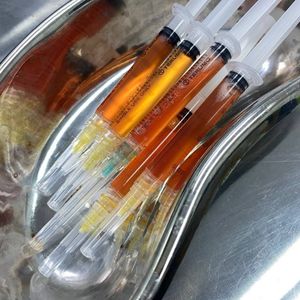
- Mechanism of Action: Autologous PRP is created by centrifuging whole blood to yield a superphysiologic concentration of platelets. Upon degranulation, these platelets release a rich cocktail of cytokines and growth factors—including Platelet-Derived Growth Factor (PDGF), Vascular Endothelial Growth Factor (VEGF), Fibroblast Growth Factor (FGF), Transforming Growth Factor-beta (TGF-β), and Insulin-Like Growth Factor (IGF-1 & 2). These factors promote angiogenesis, stimulate dermal papilla cell proliferation, and activate the Wnt/β-catenin signaling pathway.
- Intraoperative Use in Hair Transplantation:
- Graft Bathing/Holding Solution: Soaking or bathing harvested follicular unit (FU) grafts in PRP prior to implantation protects them against ischemic stress. In clinical trials (such as Uebel’s landmark study), pre-treating grafts with platelet growth factors significantly reduced graft non-survival compared to saline alone (reducing non-surviving grafts from 28.2% to 17.6%).
- Recipient & Donor Site Injections: Intradermal injection of PRP directly into the recipient bed and donor wounds speeds up revascularization, accelerates overall tissue recovery, and promotes faster, more robust graft regrowth.
- Liposomal ATP: Supplying exogenous adenosine triphosphate (ATP) directly helps maintain essential cellular metabolism and membrane stability during extended ex vivo storage.
- Aminoguanidine (AMG): As an inducible nitric oxide synthase (iNOS) inhibitor, AMG reduces toxic peroxynitrite formation from free radicals. In both in vitro and in vivo trials, AMG upregulated VEGF messenger RNA and prevented postoperative graft shedding.
- Vitamin B12: Adding vitamin B12 to graft storage media induces β-catenin transcription (a core component of the Wnt hair-growth pathway) and significantly increases hair shaft elongation.
- Arachidonic Acid Inhibitors (e.g., 14,15-EET): Help prevent apoptosis in follicular cells during storage and eliminate post-transplant effluvium.
- ACell MatriStem: An extracellular matrix derived from porcine urinary bladder containing collagens and growth factors. When combined with PRP intraoperatively, it helps recruit local progenitor cells to assist in tissue regeneration and follicle repair.
- Growth Factor Secretion: Mesenchymal stem cells derived from fat tissue (ADSCs) produce potent growth factors (such as VEGF, HGF, bFGF, PDGF, and KGF) that activate the skin’s stem cell niche.
- Therapeutic Application: Injections of autologous ADSCs or ADSC-conditioned media (harvested under hypoxic conditions) via mesotherapy techniques improve scalp microvascularization, increase hair shaft diameter, and enhance hair density.
- Stemoxydine (5%): Hair production relies on follicular stem cells transitioning between rest and activity. Stemoxydine functions as a competitive inhibitor of prolyl-4-hydroxylase and hypoxia-inducible transcription factor (HIF1). By mimicking a hypoxic microenvironment, it maintains hair follicle stem cell viability, shortens the resting (kenogen/telogen) phase, and increases overall scalp hair density.
- Low-Level Laser Therapy (LLLT): Red light laser or LED photobiomodulation (e.g., 655 nm) stimulates mitochondrial function and cellular respiration. When used as an adjunct to hair transplant surgery, LLLT reduces postoperative shedding, shortens wound healing time, and enhances graft patency.
- Microneedling: Mechanical micro-punctures induce localized platelet activation and wound-regeneration cascades. This stimulates dermal papilla cells, upregulates Wnt3a/Wnt10b/β-catenin expression, and increases local levels of VEGF and PDGF.
Biostimulators for Hair Restoration: Regenerative Injections to Support Hair Growth
Hair loss is not always just a problem of missing hair.
In many patients, the hair follicles are still present, but they have become smaller, weaker, or less active over time. This process is especially common with androgenetic alopecia, also known as male or female pattern hair loss.
That is where modern hair restoration treatments are evolving.
A hair transplant can move healthy follicles from a donor area into areas affected by thinning or baldness. However, not every patient needs a transplant immediately. Some patients have existing follicles that may benefit from additional stimulation and support.
For these patients, biostimulators and regenerative hair restoration treatments may offer another option.
At Dr Ruz Hair Transplant, regenerative approaches can include targeted injections designed to create a healthier environment around the hair follicles. Depending on the patient’s condition and treatment goals, these may include secretomes, exosomes, peptides, polynucleotides, and PLLA, alongside other established hair-loss treatments.
The goal is not simply to inject a product into the scalp.
Instead, the objective is to support the scalp environment, encourage healthier follicular activity, improve the quality of existing hair, and complement a broader hair restoration plan when appropriate.
Because every type of hair loss is different, treatment should always start with a proper assessment.
What Are Biostimulators for Hair Restoration?
Biostimulators are treatments designed to encourage the body’s own biological processes.
In hair restoration, this concept focuses on creating a more supportive environment around the hair follicle. Depending on the treatment, the goal may involve supporting cellular communication, tissue quality, blood supply, collagen production, or the follicle’s natural growth cycle.
Think of a hair follicle as a small living structure rather than simply a hole where a hair grows.
It needs an appropriate biological environment to function well.
When that environment becomes less supportive, hair can gradually become finer and shorter. Eventually, some follicles may produce very little visible hair.
Therefore, regenerative treatment aims to work with the biology of the scalp rather than simply covering the problem.
At Dr Ruz Hair Transplant, injectable regenerative treatments can be considered as part of a personalised hair restoration strategy.
Depending on the patient’s needs, the treatment may focus on the scalp alone or complement other approaches such as hair transplant surgery, medical hair-loss treatment, or supportive scalp therapies.
Why Consider Regenerative Hair Treatments?
Traditional hair-loss treatments mainly focus on controlling the processes that cause hair loss or stimulating follicles through established medications.
Regenerative treatments take a different approach.
They aim to improve the biological environment around the follicle.
For example, some regenerative therapies contain signalling molecules that may influence cellular activity. Others provide structural or nutritional support to the surrounding tissue.
Meanwhile, certain injectable treatments are designed to stimulate collagen and tissue remodelling.
The exact effect depends on the substance used.
More importantly, not every treatment works for every patient.
That is why Dr Ruz assesses the patient’s pattern of hair loss, scalp condition, existing hair density, donor area, medical history, and treatment objectives before recommending a suitable approach.
The right treatment is not necessarily the newest treatment.
It is the treatment that makes sense for your individual hair.
Platelet Rich PLasma for Hair Restoration
Our Platelet is Rich with Growth Factors.
These Growth Factors can help stimulate hair growth when injected to the hair.
Cytokines for Hair Restoration
Another interesting treatment is cytokines in which it can support hair growth when injected to the hair.
Secretomes for Hair Restoration
One of the more interesting areas of regenerative medicine is the use of secretomes.
A secretome refers to the collection of biologically active substances released by cells. These substances can include proteins, growth factors, cytokines, peptides, and other signalling molecules.
In simple terms, cells communicate with their surrounding environment.
Secretome-based treatments attempt to make use of these biological signals to support tissue repair and cellular activity.
In hair restoration, this approach is being investigated for its potential to support the follicular environment and encourage healthier hair growth.
The attraction is easy to understand.
Rather than thinking only about the hair shaft, regenerative treatment considers the environment surrounding the follicle.
Consequently, secretome-based approaches may be used as part of a broader strategy for patients with thinning hair.
However, the quality and composition of secretome products can vary considerably. Therefore, treatment should be performed using an appropriate medical product and protocol under professional supervision.
At Dr Ruz, secretome-based regenerative treatment can be considered when the clinical assessment suggests that biological stimulation may complement the patient’s overall hair restoration plan.
Exosomes for Hair Growth
Exosomes have attracted considerable attention in regenerative medicine and hair restoration.
They are tiny extracellular vesicles involved in communication between cells. In laboratory and early clinical research, exosomes have been studied for their ability to carry signalling molecules that may influence cellular behaviour.
For hair restoration, researchers are interested in whether these signals can support the activity of cells involved in the hair follicle cycle.
The potential appeal is that exosomes work as biological messengers.
Rather than simply supplying one ingredient, they can carry multiple signalling molecules.
However, it is important to understand where the science currently stands. Exosome-based hair treatments are an emerging area, and research continues to determine which sources, preparations, concentrations, and treatment protocols are most effective and consistent.
Therefore, exosomes should not be marketed as a guaranteed cure for baldness.
Instead, they can be considered a regenerative adjunct for selected patients.
At Dr Ruz Hair Transplant, exosome-based treatment may be discussed as part of an individualised hair restoration program when appropriate.
The purpose is to support the scalp and existing follicles, not to promise that every dormant follicle will grow new hair.
Peptides for Hair Restoration
Peptides are another area of interest in modern hair restoration.
A peptide is a short chain of amino acids. In the body, different peptides can perform different biological functions, including cellular signalling.
Some peptides have been investigated for their potential role in processes relevant to hair growth, such as follicular activity, tissue repair, inflammation, and cellular communication.
That makes peptides particularly interesting as a supportive component of regenerative hair treatment.
However, “peptide treatment” is not one single therapy.
Different peptides have different properties, mechanisms, and levels of evidence.
Therefore, it is important to understand exactly which peptide is being used and why.
At Dr Ruz, the decision to use peptide-based injections depends on the patient’s clinical situation and the overall treatment strategy.
The aim is to use regenerative medicine intelligently rather than simply adding more products to a treatment plan.
Polynucleotides for Hair and Scalp Health
Polynucleotides, often referred to as PDRN or PN depending on the specific formulation and application, have become increasingly popular in regenerative and aesthetic medicine.
These treatments are designed to support tissue repair and improve the biological environment of treated tissue.
In hair restoration, interest in polynucleotides comes from their potential effects on tissue regeneration, hydration, cellular signalling, and the scalp environment.
A healthier scalp may provide a better environment for existing follicles.
For patients with thinning hair, that can be an important part of a broader strategy.
However, polynucleotides should not be confused with a hair transplant.
A hair transplant physically moves follicles from one part of the scalp to another. Polynucleotide treatment does not create a new donor supply.
Instead, it is better understood as a regenerative or supportive treatment that may be considered for suitable patients.
At Dr Ruz Hair Transplant, polynucleotide injections can be incorporated into a personalised hair restoration plan when clinically appropriate.
The treatment may be particularly interesting for patients who want to support the quality of their existing hair and scalp rather than immediately proceed with surgery.
PLLA as a Biostimulator for the Scalp
Another treatment that has gained attention in regenerative aesthetics is PLLA, or poly-L-lactic acid.
PLLA is a biostimulatory material that has been used in medicine and aesthetics for tissue stimulation and collagen production.
Unlike a traditional filler that mainly adds volume immediately, PLLA works by encouraging a biological response over time.
That makes it interesting from a regenerative perspective.
In the scalp, the objective is not simply to add volume. Instead, carefully planned treatment may aim to improve the quality of the surrounding tissue and create a more supportive environment.
PLLA is therefore different from exosomes, secretomes, peptides, and polynucleotides.
Each has a different biological profile and potential role.
For that reason, combining treatments should never be based on popularity alone.
Dr Ruz can determine whether PLLA or another regenerative option makes sense based on the patient’s scalp condition, hair-loss pattern, and overall restoration goals.
Can Biostimulators Regrow Hair?
This is one of the most common questions patients ask.
The honest answer is that it depends.
Biostimulators may help support existing follicles in suitable patients, but they cannot guarantee the regeneration of completely destroyed follicles.
If a follicle is still functioning but producing increasingly thin hair, stimulation may have a different potential than in an area that has been completely bald for many years.
This distinction matters.
Early thinning can sometimes leave more treatment options available.
Advanced baldness may require a different approach, such as hair transplantation.
Therefore, the best treatment depends on the condition of the follicles rather than simply the amount of hair you see in the mirror.
A clinical assessment can help determine whether the follicles appear miniaturised, inactive, or permanently lost.
Biostimulators vs Hair Transplant
Biostimulators and hair transplantation are not necessarily competing treatments.
In many cases, they can complement each other.
A hair transplant moves follicles into an area where additional density is needed. Regenerative injections may then be considered to support the surrounding scalp and native hair.
For example, a patient may have significant frontal hair loss that requires transplantation but also have thinning native hair behind the transplant zone.
In that situation, the transplant addresses the missing density while appropriate medical or regenerative treatment may help support the remaining native hair.
Another patient may have early or moderate thinning without a clear need for surgery.
For that person, a regenerative treatment plan may be considered before a transplant.
Consequently, the question should not simply be, “Which treatment is best?”
A better question is:
What does my hair need at this stage?
That is the approach behind personalised hair restoration at Dr Ruz.
Biostimulators After Hair Transplant
Regenerative injections may also have a role as an adjunct to hair transplant treatment.
A hair transplant involves removing follicles from a donor area and placing them into the recipient area. During this process, the scalp undergoes controlled surgical trauma.
The transplanted follicles then need to establish themselves and reconnect with their blood supply.
That is why the biological environment matters.
Regenerative treatments may be considered to support tissue recovery or the surrounding follicular environment.
However, the exact timing and choice of treatment should be individualised.
Some patients may benefit from supportive treatment during the recovery period. Others may be better suited to treatment later, once the scalp has healed.
Dr Ruz can determine the appropriate timing based on the patient’s surgery, healing progress, hair characteristics, and overall treatment plan.
How Do Regenerative Hair Injections Work?
It helps to think of the scalp as an ecosystem.
Hair follicles do not function independently. They interact with surrounding skin cells, blood vessels, extracellular matrix, signalling molecules, and immune processes.
When hair becomes thinner, several biological changes can occur.
The growth phase may become shorter. The follicle can become progressively smaller. Hair shafts can become finer. The surrounding tissue can also change.
Regenerative treatment attempts to influence this environment.
Depending on the therapy, the treatment may provide signalling molecules, stimulate tissue remodelling, support cellular communication, or encourage a more favourable scalp environment.
The result is not instant.
Hair grows slowly.
Therefore, any potential improvement generally needs to be assessed over months rather than days.
This is also why a structured follow-up program is so valuable.
How Many Treatments Will You Need?
There is no universal number of regenerative hair treatments.
The appropriate schedule depends on the treatment selected, the patient’s degree of hair loss, scalp condition, response to previous treatment, and overall goals.
Some protocols use a series of treatments.
Others may involve maintenance sessions at longer intervals.
Furthermore, regenerative treatment may be combined with other therapies.
Rather than following a one-size-fits-all package, Dr Ruz can assess your progress and adjust the plan according to your response.
This approach helps avoid unnecessary treatment while keeping the focus on the patient’s actual hair.
Are Biostimulators Suitable for Everyone?
No.
Although regenerative hair treatments can be useful for selected patients, they are not suitable for every person with hair loss.
The first step should always be identifying the cause of the hair loss.
Pattern hair loss is different from sudden shedding caused by illness, nutritional deficiency, hormonal changes, inflammatory scalp disease, or other medical conditions.
Treating the scalp without understanding the cause can miss the real problem.
Therefore, Dr Ruz will consider the patient’s history, scalp appearance, pattern of thinning, existing hair, and other relevant factors before recommending treatment.
This assessment also helps determine whether regenerative injections, medication, hair transplantation, or a combination would make the most sense.
Regenerative Hair Restoration Is About Supporting Existing Hair
One of the biggest advantages of a regenerative approach is that it can focus on hair that is already present.
A transplant adds follicles.
Biostimulation may aim to support follicles that are still functioning.
That distinction makes regenerative treatment particularly interesting during the earlier stages of hair thinning.
For patients with miniaturised hair, the goal may be to improve the quality and longevity of those follicles.
At the same time, patients with advanced hair loss may need transplanted follicles to restore areas where hair has already been lost.
In practice, the best results may come from combining different strategies rather than relying on a single treatment.
A Personalised Approach at Dr Ruz Hair Transplant
Hair restoration should not be a race to find the newest injection.
It should be a carefully planned medical process.
At Dr Ruz Hair Transplant, regenerative options such as secretomes, exosomes, peptides, polynucleotides, and PLLA can be considered according to each patient’s needs.
The purpose is to select the right tool for the right biological problem.
For one patient, an injectable regenerative treatment may be appropriate.
For another, established medical hair-loss therapy may provide a better foundation.
Someone with significant baldness may benefit more from a hair transplant.
Meanwhile, some patients may benefit from a combination approach.
This personalised strategy is particularly important because hair loss changes over time.
Your treatment plan may need to change with it.
Why Long-Term Follow-Up Matters
Hair restoration is measured in months and years, not days.
A regenerative injection may be completed in a short appointment, but the biological response takes considerably longer.
That is why follow-up is such an important part of treatment at Dr Ruz.
Your hair can be monitored over time to assess whether the treatment is achieving its intended purpose.
Photos and clinical examinations can help track changes in density, hair calibre, scalp condition, and overall appearance.
If your response is not as expected, the treatment plan can be reviewed.
If your hair is progressing well, the focus can shift towards maintenance.
This long-term perspective helps turn hair restoration into an ongoing strategy rather than a single isolated treatment.
What Results Should You Expect?
It is important to have realistic expectations.
Biostimulators are not magic injections.
They cannot guarantee that completely bald areas will suddenly grow thick hair.
Instead, the potential benefit is generally more relevant to follicles that remain viable and capable of responding.
Results also take time.
Hair follicles follow a biological growth cycle, so visible changes may take several months to become noticeable.
Some patients may see improvement in hair thickness or quality before they notice a dramatic change in density.
Others may require a combination of therapies to achieve their desired result.
For this reason, Dr Ruz evaluates progress over time rather than judging treatment after only a few weeks.
The Future of Regenerative Hair Restoration
Hair restoration is moving beyond the traditional idea of simply replacing lost hair.
Researchers are increasingly interested in cellular communication, regenerative medicine, tissue engineering, extracellular vesicles, growth factors, peptides, and other biological pathways involved in follicle activity.
Secretomes and exosomes are part of this rapidly developing field.
Polynucleotides and other regenerative compounds are also attracting interest.
Meanwhile, biostimulatory materials such as PLLA offer another way to influence tissue quality.
These developments are exciting.
However, innovation should always be balanced with evidence, patient safety, and realistic expectations.
At Dr Ruz, the objective is not to use a treatment simply because it is new.
Instead, the goal is to understand what the treatment can realistically do and determine whether it fits the patient’s individual hair restoration plan.
Give Your Hair More Than a Temporary Fix
Hair loss can affect far more than your appearance.
It can change how you feel when you look in the mirror, how you style your hair, and sometimes how confident you feel in social or professional situations.
Fortunately, modern hair restoration offers more options than ever before.
Hair transplantation can restore follicles to areas of permanent hair loss.
Medical treatments can help manage ongoing hair loss.
Meanwhile, regenerative and biostimulator treatments may provide additional support for suitable patients with thinning or miniaturised hair.
At Dr Ruz Hair Transplant, treatments such as secretomes, exosomes, peptides, polynucleotides, and PLLA injections can be considered as part of a personalised approach to hair restoration.
The goal is not to promise overnight transformation.
Instead, the focus is on creating the best possible conditions for healthier, stronger-looking hair while addressing the underlying pattern of hair loss.
Most importantly, your treatment should evolve with your hair.
An assessment today can determine where you are now. Follow-up can show how your hair responds. Further treatment can then be considered when it is genuinely appropriate.
That is what makes regenerative hair restoration different from simply buying another hair product.
It is a personalised, medically guided approach to supporting the biology of your hair and scalp.
If you are experiencing thinning hair, early-stage hair loss, or ongoing loss after a hair transplant, Dr Ruz can assess your scalp and discuss whether regenerative treatment may be appropriate for you.
Your hair may need more than one solution.
The right combination, delivered at the right time, can make the difference between simply treating hair loss and building a long-term hair restoration strategy.