
About Hair Restoration & Hair Transplant: Natural Hair Restoration Starts With Understanding Your Hair
Hair loss can change more than your appearance.
Over time, thinning hair can affect the way you see yourself. You may notice a receding hairline in photographs. Perhaps your crown looks thinner under bright light. Or maybe you have started avoiding certain hairstyles because they expose areas of reduced density.
However, hair loss is not the same for everyone.
Some people experience gradual male pattern hair loss. Others develop sudden shedding after stress, illness, nutritional changes, or hormonal changes. Some may have thinning caused by ageing, while others may have a combination of different factors.
Therefore, effective hair restoration should begin with understanding the reason behind the hair loss.
At Dr Ruz Hair Transplant, hair restoration is approached as a long-term process rather than simply adding hair to an area that looks thin.
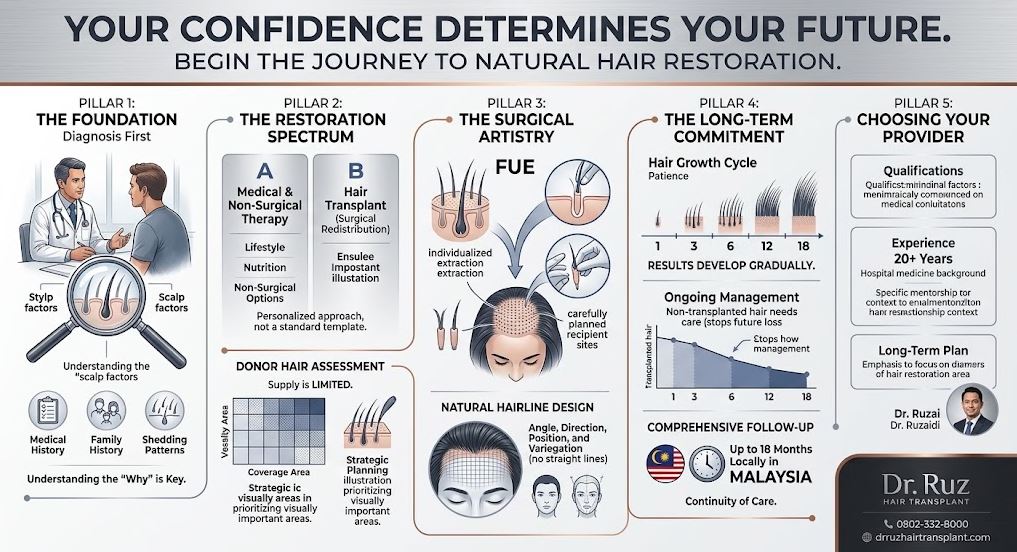
The goal is to understand your hair loss pattern, assess your donor hair, design an appropriate hairline, and develop a treatment plan that considers both your current appearance and your future hair.
What Is Hair Restoration?
Hair restoration refers to a range of medical and surgical approaches used to improve the appearance of thinning or lost hair.
A hair restoration plan may include medical treatment, lifestyle and nutritional considerations, scalp assessment, non-surgical therapies, or hair transplantation.
In suitable patients, a hair transplant can restore hair to areas where significant permanent thinning has occurred.
However, transplantation is not automatically the first step.
A proper assessment can help determine whether your hair loss may respond to medical treatment or whether surgery may be appropriate.
This distinction matters because your existing hair is just as important as the hair that can be transplanted.
For example, a person with early-stage thinning may benefit from stabilising the hair loss before considering surgery. On the other hand, someone with a stable pattern of permanent hair loss and an adequate donor supply may be considered for transplantation.
As a result, hair restoration should always be personalised.
What Is a Hair Transplant?
A hair transplant is a surgical procedure that moves hair follicles from a suitable donor area to areas affected by permanent hair loss.
The principle behind modern hair transplantation is relatively straightforward.
Healthy follicles are carefully selected from areas where the hair is more resistant to the effects of pattern hair loss. These follicles are then transplanted into areas where hair density has reduced.
The procedure does not create new hair follicles.
Instead, it redistributes suitable existing follicles.
That is why donor assessment is so important.
The amount, quality, density, and characteristics of your donor hair can influence what can realistically be achieved.
At Dr Ruz Hair Transplant, the treatment plan therefore considers the donor area and recipient area together.
The objective is not simply to place as many grafts as possible.
Instead, the focus is on using the available donor hair thoughtfully.
FUE Hair Transplant
One of the commonly used techniques in modern hair transplantation is Follicular Unit Extraction, or FUE.
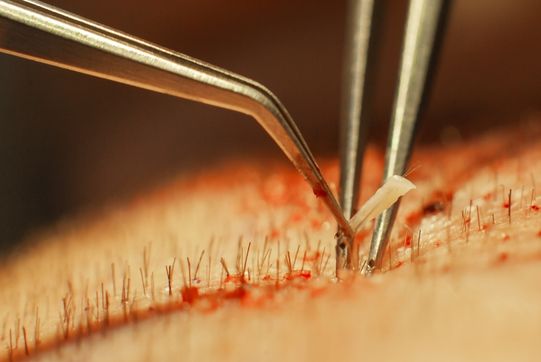
During FUE, individual follicular units are extracted from the donor area using specialised instruments.
The selected follicles are then prepared and placed into carefully planned recipient sites.
Because the follicles are transplanted individually, the procedure allows the doctor to consider the direction, angle, distribution, and positioning of the transplanted hair.
These details can influence how natural the final result appears.
The hairline requires particular attention.
A hairline that is too straight, too low, or overly dense can look unnatural. Therefore, hairline design should consider factors such as age, facial proportions, existing hair characteristics, donor availability, and long-term hair loss.
At Dr Ruz Hair Transplant, the aim is to create a hairline that works with your face rather than simply following a standard template.
Natural Hairline Design
Your hairline is one of the most visible features of your appearance.
Even a relatively small change can alter the way your face looks.
For that reason, hairline design is an important part of hair transplantation.
A natural hairline normally has variation.
It does not look like a perfectly drawn line.
The transition from the forehead into the hair should therefore be planned carefully. The density and positioning of grafts can also be adjusted across different areas.
For example, the frontal zone may require careful placement to create a natural transition. Behind it, additional density may be planned according to the available donor hair and the patient’s pattern of hair loss.
This approach helps avoid using too much donor hair in one area.
After all, donor hair is a limited resource.
A good hair restoration plan must consider not only how the hairline looks immediately after surgery, but also how the overall hair pattern may develop in the future.
Donor Hair Matters
Many people focus almost entirely on the area where they have lost hair.
Yet the donor area is equally important.
Your donor region provides the follicles used for transplantation. Therefore, its density and characteristics help determine how much hair can reasonably be redistributed.
During consultation, donor hair can be assessed for factors such as density, hair calibre, pattern, and available coverage.
This assessment helps establish realistic expectations.
For example, extensive hair loss does not necessarily mean that unlimited transplantation is possible.
A large bald area requires more coverage, while the donor supply remains limited.
Therefore, strategic planning becomes essential.
Rather than attempting to cover every area equally, a treatment plan may prioritise the most visually important areas first.
This can help make better use of the available donor follicles.
Hair Restoration Is More Than Surgery
Hair transplantation can restore hair in suitable areas.
However, it does not necessarily stop future hair loss in your existing, non-transplanted hair.
This is an important point that many patients overlook.
Pattern hair loss can continue to affect native hair surrounding the transplanted follicles.
Therefore, long-term hair restoration may involve more than a single procedure.
Depending on the individual’s condition, medical treatment may be considered to help manage ongoing hair loss.
The appropriate approach depends on factors such as the cause of hair loss, age, pattern, medical history, existing hair density, and treatment goals.
For this reason, consultation should come before deciding on a procedure.
Why Diagnosis Comes First
Not every type of hair loss requires a hair transplant.
A proper diagnosis can help identify the underlying pattern and determine the appropriate treatment direction.
During an assessment, the doctor may consider your medical history, family history, duration of hair loss, pattern of thinning, scalp condition, and previous treatments.
The scalp and donor area may also be examined.
In some cases, additional investigations may be appropriate.
This process helps distinguish different forms of hair loss.
For example, gradual pattern hair loss requires a different approach from sudden diffuse shedding. Similarly, inflammatory or scarring conditions may require medical evaluation before transplantation is considered.
Therefore, the first question should not simply be:
“How many grafts do I need?”
A better starting point is:
“Why am I losing my hair, and what is the most appropriate way to manage it?”
That question can lead to a more thoughtful treatment plan.
Personalised Hair Restoration Planning
No two heads of hair are exactly the same.
Hair colour, thickness, curl, density, donor availability, facial structure, and hair-loss pattern can all differ.
Consequently, a hair transplant plan should not be copied from another patient.
At Dr Ruz Hair Transplant, treatment planning considers the individual.
The process can involve assessing:
- Your current hair-loss pattern
- Your existing hair density
- Your donor area
- Your hair characteristics
- Your facial proportions
- Your desired hairline
- Your long-term expectations
- The potential progression of existing hair loss
This allows the treatment strategy to be built around your individual situation.
The purpose is not simply to perform a procedure.
It is to create a restoration plan that makes sense for your hair today while considering your hair tomorrow.
The Importance of Long-Term Follow-Up
Hair restoration does not end when the procedure is completed.
The transplanted follicles need time to grow, while the scalp and surrounding hair continue to change.
Therefore, follow-up is an important part of the restoration journey.
At Dr Ruz Hair Transplant, patients can receive comprehensive follow-up in Malaysia for up to 18 months following their hair transplant.
This provides an opportunity to monitor progress over time and address questions as the hair develops.
Long-term follow-up also helps maintain continuity of care.
Instead of travelling overseas for surgery and then returning home without the same treatment team, patients can have their follow-up locally in Malaysia.
This can make the post-treatment journey more convenient and structured.
Hair Transplantation Requires Patience
One of the most important things to understand before undergoing a hair transplant is that results develop gradually.
A transplant is not an instant solution.
The transplanted follicles need time to go through their natural growth cycle. Changes therefore occur progressively rather than overnight.
During the recovery period, patients may experience temporary changes in the appearance of the transplanted area.
Over the following months, new growth can gradually become more noticeable.
The final appearance develops over time.
Therefore, realistic expectations are an essential part of good hair restoration.
A responsible consultation should explain what the procedure can potentially achieve, as well as its limitations.
Why Natural-Looking Results Matter
The objective of hair restoration is not simply to have more hair.
It is to have hair that looks appropriate for you.
A natural result should work with your facial structure, existing hair, age, and overall appearance.
That is why graft placement requires careful planning.
The direction of the hair should generally follow the natural pattern of growth. Density should also be considered rather than simply maximised.
Furthermore, the available donor hair needs to be managed carefully.
A restoration plan that looks impressive at the front but uses donor hair inefficiently may create challenges later.
Therefore, thoughtful planning can be more valuable than simply focusing on graft numbers.
Hair Restoration for Men and Women
Hair loss affects both men and women.
Although the patterns can differ, the emotional impact can be significant for anyone experiencing visible thinning.
Men commonly notice recession around the temples, frontal thinning, or crown loss.
Women may experience diffuse thinning or reduced density across larger areas.
However, the suitability of hair transplantation depends on the individual’s diagnosis and donor hair characteristics.
For that reason, women and men should both receive an individual assessment rather than assuming that a particular treatment is automatically suitable.
The same principle applies to age.
Being young does not necessarily mean that transplantation is inappropriate. Likewise, being older does not automatically make someone unsuitable.
The important consideration is the overall clinical picture.
Choosing a Hair Transplant Doctor
Choosing a hair restoration provider involves more than comparing prices.
A hair transplant is a medical procedure.
Therefore, patients should consider the doctor’s medical qualifications, experience, approach to diagnosis, surgical technique, treatment planning, and follow-up arrangements.
It is also important to understand what happens after surgery.
Ask who will monitor your progress.
Ask how future hair loss will be managed.
Ask whether your treatment plan considers your donor supply.
Most importantly, make sure you understand what can realistically be achieved.
At Dr Ruz Hair Transplant, these considerations form part of the consultation process.
About Dr. Ruz @ Dr. Ruzaidi
Dr. Ruz @ Dr. Ruzaidi is a Malaysian medical doctor with more than 20 years of medical experience.
His medical background includes experience across hospital medicine and surgery, followed by private practice and aesthetic medicine.
His early medical training included rotations through General Medicine, Surgery, Obstetrics and Gynaecology, Paediatrics, Orthopaedics, and Emergency Medicine.
He also received additional exposure to pathology and transfusion medicine, including Histopathology, Haematopathology, Chemical Pathology, and Forensic Pathology.
This broad medical foundation contributes to his approach to patient assessment.
His hair restoration journey developed further through four years of mentorship under Dr. Shaharom Sulaiman at Dr Shah Clinic, part of DRS Medical Group in Subang Jaya.
His hair restoration work includes FUE hair transplantation, natural hairline design, density planning, donor assessment, and postoperative care.
Today, Dr Ruz Hair Transplant focuses on providing personalised hair restoration for patients seeking a medically guided approach in Malaysia.
A More Thoughtful Approach to Hair Restoration
Hair loss can feel like a simple cosmetic problem.
Yet the solution is rarely that simple.
Your hair has a growth cycle. Your donor supply is limited. Your existing hair can continue to change. Your facial structure also influences how a hairline should look.
Therefore, successful hair restoration requires more than placing grafts.
It requires assessment.
It requires planning.
It requires surgical precision.
Most importantly, it requires a long-term perspective.
At Dr Ruz Hair Transplant, the focus is on helping patients understand their hair loss before deciding on treatment.
If transplantation is appropriate, the procedure can then be planned around the patient’s individual characteristics and goals.
If another treatment approach is more suitable, that should also be considered.
Because the objective is not simply to perform a hair transplant.
The objective is to create a thoughtful hair restoration plan that supports your appearance, confidence, and long-term hair goals.
Begin Your Hair Restoration Journey
If you are experiencing hair loss, thinning hair, a receding hairline, or reduced density, the first step is understanding your condition.
A personalised consultation can help you understand your current hair-loss pattern, donor area, treatment options, and realistic expectations.
You do not have to decide on surgery immediately.
Start with information.
Understand your options.
Then make a decision based on your individual needs.
Dr Ruz Hair Transplant
Dr. Ruz @ Dr. Ruzaidi
Hair Restoration & Hair Transplant Malaysia
Phone: +6018-9404977
Website: drruzhairtransplant.com
Because your confidence determines your future.